How to talk about your weekend in English
On Saturday I went to a concert, and then we got pizza.
“On Saturday I went to a concert, and after that we ate pizza.”
When: Answering what you did on the weekend
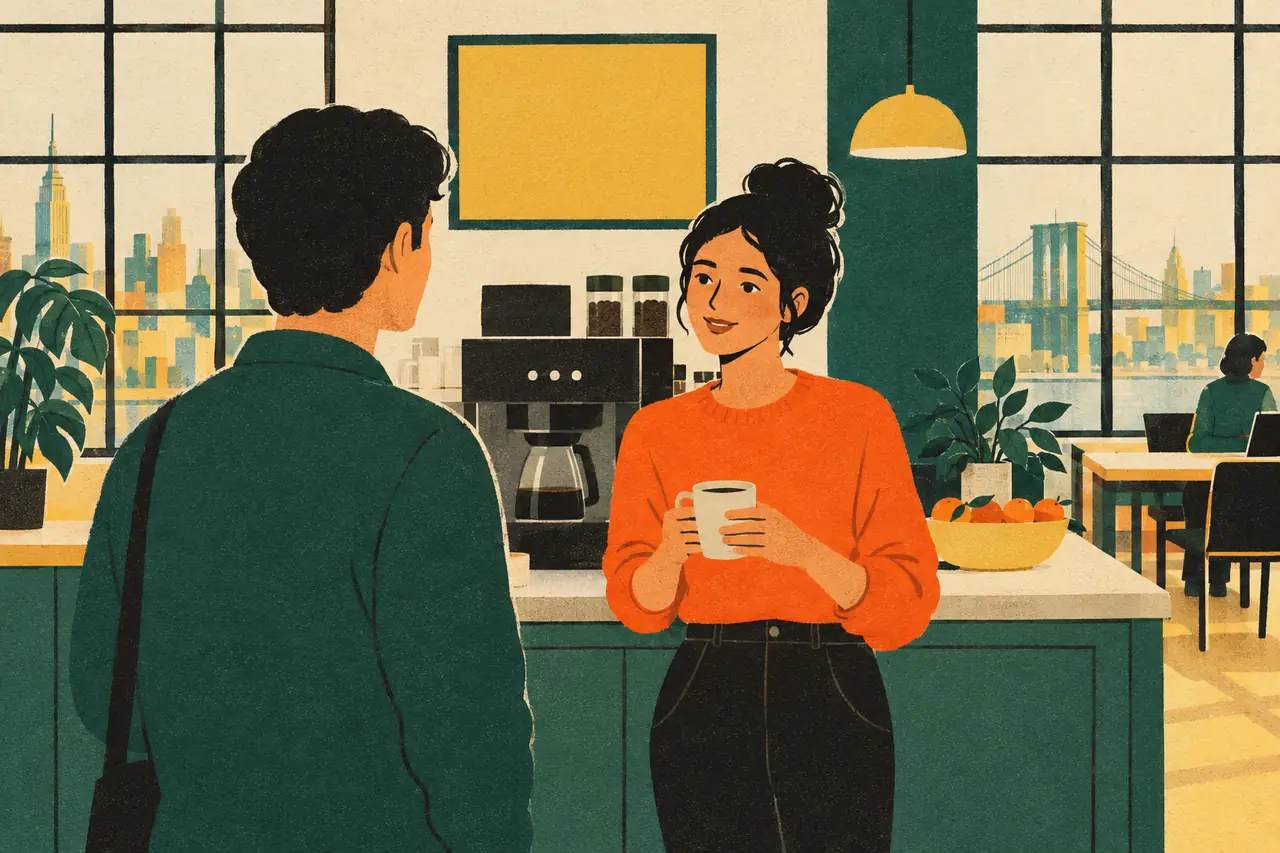
The moment
It's Monday morning by the coffee machine in your Brooklyn office, and a coworker asks, 'How was your weekend?' Tell them two or three things you did, then ask about theirs.
A2 · Unit 4 · Small talk & stories
The lines
Two things in one line
Link your weekend with 'and then': 'On Saturday I went to a concert, and then we got pizza.' Change the parts: 'I saw a movie', 'I met some friends', 'I slept all afternoon'. The pattern still works.
On Saturday I went to a concert, and then we got pizza.
“On Saturday I went to a concert, and after that we ate pizza.”
When to use it: Answering what you did on the weekend
What you’ll hear back: Oh, nice! Who'd you see? (Oh, good! Which band did you see?)
Passing the story back
After your story, ask 'How about you? Did you do anything fun?' This gives the other person a turn. Without it, the chat stops fast.
How about you? Did you do anything fun?
“And you? Did you do something fun?”
When to use it: Right after you finish your own story
What you’ll hear back: Not really, I just chilled at home. (No, I just relaxed at home.)
Words for this scene
| Word or phrase | Say it | Meaning |
|---|---|---|
| It was pretty low-key. | ih-WUZ PRIH-dee LOH-KEE | It was quiet and relaxed. Nothing big happened. |
My weekend was pretty low-key. I cleaned and watched TV. My weekend was quiet. I cleaned and watched TV. Tip: A totally normal answer; Americans don't expect exciting weekends. | ||
| That sounds like fun! | that SOWNZ laik FUN | I think that was a good time for you. |
You went to Coney Island? That sounds like fun! You went to Coney Island? I think you had a good time! Tip: Say it with energy; flat tone sounds bored or sarcastic. | ||
| It was a blast. | ih-wuz-uh BLAST | It was really, really fun. |
We went bowling on Friday night. It was a blast. We went bowling on Friday night. It was very fun. Tip: Casual; use it with friends and coworkers, not in job interviews. | ||
Your objective
Tell them two things you did at the weekend; when they ask about one, give a detail, then ask about their weekend and react.
- two things you did
- a detail when they ask more
- a question about their weekend
Lines that get it done
- On Saturday I went to a concert, and then we got pizza.
- It was pretty low-key. · It was quiet and relaxed. Nothing big happened.
In the live scene the objective stays on screen, and the Replay afterwards says whether you got it done.
Check yourself
1. You want to say you went to a concert on Saturday and after that you ate pizza. Which sentence is right?
- On Saturday I went to a concert, and then we got pizza.
- On Saturday I go to a concert, and then we get pizza.
- On Saturday I goed to a concert, and then we got pizza.
- On Saturday I went to a concert, and then we get pizza.
Show the answer
On Saturday I went to a concert, and then we got pizza.
Both actions are finished, so both verbs are in the past: 'went' and 'got'. 'And then' links them.
2. You finished telling your weekend story. What do you say to give your coworker a turn?
- How about you? Did you do anything fun?
- How about you? Do you do anything fun?
- And you? What you did?
- How about you? Are you doing anything fun?
Show the answer
How about you? Did you do anything fun?
The weekend is over, so ask in the past: 'Did you do...?' The other options use the wrong time or wrong word order.
3. Your coworker says, 'My weekend was pretty low-key.' What do they mean?
- They had a quiet, relaxing weekend.
- They had a terrible weekend.
- They went to a big party.
- They lost their keys this weekend.
Show the answer
They had a quiet, relaxing weekend.
'Low-key' means calm and simple. It's not bad; it's just quiet.