How to ask how much something costs in Spanish
¿Cuánto cuesta?
“How much is it?”
When: Pointing at one item with no price on it
The moment
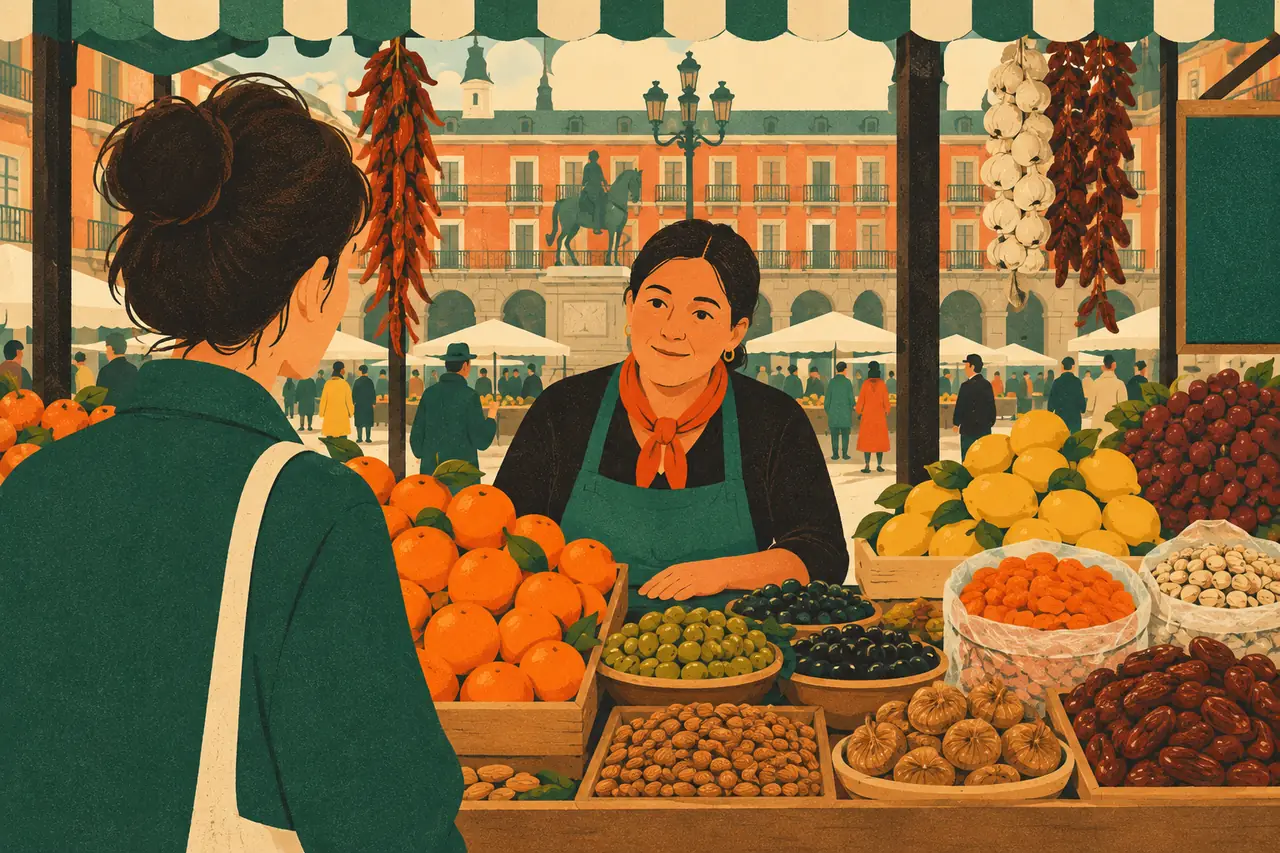
You are at a busy market stall in Madrid, fruit and snacks piled high and not a price tag in sight. You want to find out what two of them cost before you hand over any money.
A1 · Unit 1 · First words
The lines
Asking what something costs
Point at the thing and ask "¿Cuánto cuesta?" It works for a single item anywhere: market stall, kiosk, shop shelf.
¿Cuánto cuesta?
“How much is it?”
When to use it: Pointing at one item with no price on it
What you’ll hear back: Un euro con veinte. (One euro twenty.)
Catching the price
Prices come out euros first, cents after: "Son dos euros cincuenta." If you are not sure you heard it, repeat the same words back as a question.
Son dos euros cincuenta.
“That's two euros fifty.”
When to use it: Checking the number you just heard at the till
What you’ll hear back: Sí, eso es. (Yes, that's right.)
Words for this scene
| Spanish | Say it | English |
|---|---|---|
| ¿Cuánto es todo? | KWAN-toh ess TOH-doh | How much is it all? |
Ya está, ¿cuánto es todo? That's everything, how much is it all? Tip: Use it once you've stopped choosing, to ask for the total. | ||
| Es muy caro | ess mwee KAH-roh | It's very expensive |
Uf, es muy caro para mí. Oof, that's too expensive for me. Tip: Fine at street markets; in normal shops prices are fixed. | ||
| ¡Qué barato! | keh bah-RAH-toh | That's cheap! |
¡Qué barato! Ponme dos. That's cheap! Give me two. Tip: It lands as a compliment to the seller, so say it cheerfully. | ||
Your objective
Ask what two different things cost, then say which one you’ll take and how many.
- the price of two things
- which one you want
- how many
Lines that get it done
- ¿Cuánto cuesta?
- ¡Qué barato! Ponme dos. · That's cheap! Give me two.
- Uf, es muy caro para mí. · Oof, that's too expensive for me.
In the live scene the objective stays on screen, and the Replay afterwards says whether you got it done.
Check yourself
1. You point at a pastry that has no price on it. What do you ask?
- ¿Cuánto cuesta?
- ¿Cuánto tiempo?
- ¿Cuántos son?
- ¿Qué tal?
Show the answer
¿Cuánto cuesta?
"¿Cuánto cuesta?" asks the price of the one thing you are pointing at.
2. Which of these means three euros fifty?
- Tres euros cincuenta
- Trece euros
- Tres euros quince
- Cinco euros treinta
Show the answer
Tres euros cincuenta
The euros come first and the cents after: tres (3), then cincuenta (50).
3. The seller names a price far above what you wanted to pay. What do you say?
- Es muy caro.
- ¡Qué barato!
- Sí, eso es.
- ¿Cuánto es todo?
Show the answer
Es muy caro.
"Es muy caro" tells the seller the price is too high for you.