How to Read Italian: Double Letters, C and G, Gli and Gn
How to read Italian as a beginner: the vowels, c and g before e and i, gli and gn, double consonants and stress, with a Roman café order to read aloud.
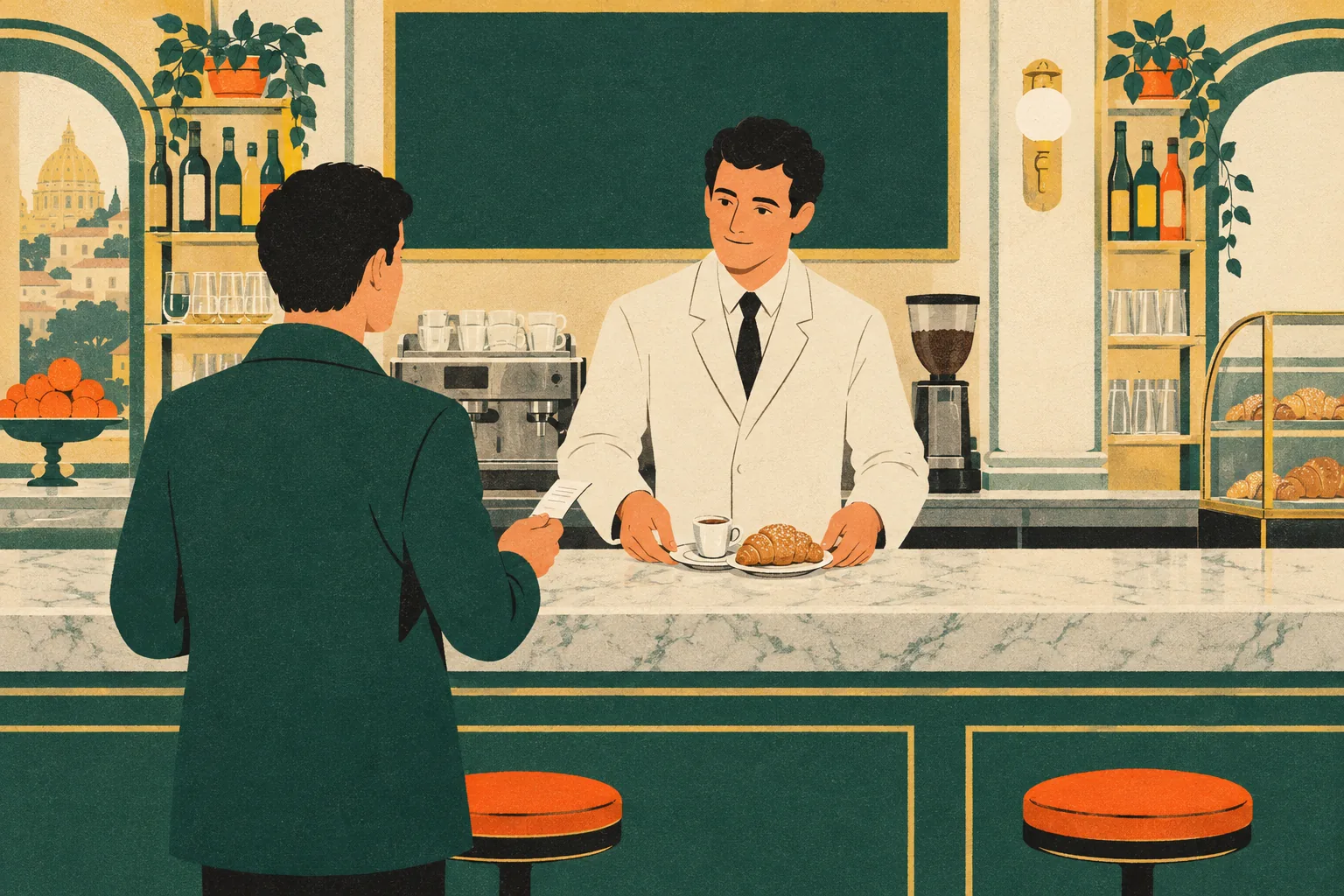
Linguino · Sep 23, 2026 · 10 min read
To read Italian, learn five vowel sounds, what c and g do before e and i, the two letter groups gli and gn, and one habit that English does not have: a double consonant is held longer. Italian spelling follows its sounds closely, so once you know these rules you can sound out almost any word, even one you have never seen; only the stressed syllable sometimes has to be learned by ear. Understanding what it means is a separate step.
This guide covers the alphabet, the rules that matter most when you start, the accent mark, and the mistakes English speakers often make. Then you will read a café order out loud, line by line, and check yourself with audio.
How does the Italian alphabet work?
Italian uses the Latin alphabet you already know. Native Italian words use 21 letters; j, k, w, x and y appear mostly in words borrowed from other languages, such as weekend or taxi. There are no extra letters, only an accent mark over some vowels (à è é ì ò ù) and the apostrophe, which you will see often.
Almost every letter you see is pronounced. The main exception is h, which is always silent. It appears in a few short verb forms (ho, “I have”, sounds like “oh”) and, more importantly, after c and g to keep them hard, as you will see below.
How do you pronounce Italian vowels?
Each Italian vowel has one clear sound, and it keeps that sound when the syllable is not stressed. English speakers tend to shorten unstressed vowels into a quiet “uh”. In Italian, the last vowel of cornetto is a full “o”, and the last vowel of crema is a full “a”.
| Vowel | Sounds like | Example |
|---|---|---|
| a | the “a” in “father” | pasta |
| e | the “e” in “bed” or the “ay” in “day”, without the glide | crema (cream) |
| i | the “ee” in “see” | vino (wine) |
| o | the “o” in “port” (open), or closer to the “o” in “go” without the glide (closed) | dolce (sweet, closed o) |
| u | the “oo” in “food” | zucchero (sugar) |
Italian has an open and a closed e and o; the spelling rarely shows which, and regions do not always agree. At the start, keep every vowel short and pure: no is one clean “o”, not “no-oo”. If you want to check a word, the DiPI online pronunciation dictionary gives the standard pronunciation.
When two vowels meet, say both: euro is “EH-oo-roh”, and buono is “BWOH-noh”.
How do c and g work in Italian?
This is the one rule you have to learn before anything else, because it appears on every menu. C and g each have a hard sound and a soft sound, and the next letter decides which one you use.
| Spelling | Sound | Example |
|---|---|---|
| c before a, o, u | “k” | caffè, cornetto |
| c before e, i | “ch” in “church” | dolce, cappuccino |
| ch before e, i | “k” (the h keeps it hard) | chiuso (closed) |
| g before a, o, u | “g” in “go” | gusto (flavour) |
| g before e, i | “j” in “jam” | gelato |
| gh before e, i | “g” in “go” | spaghetti |
| ci, gi before a, o, u | “ch”, “j”; the i is usually silent | ciao, giorno |
| sc before e, i | “sh” in “show” | uscita (exit) |
| sc before a, o, u, and sch | “sk” | scontrino, schiuma (foam) |
| qu | “kw” | quanto |
This is the most common mistake for English speakers. In Italian, ch is always a “k”: chiuso is “KYOO-zoh”. The English “ch” sound is written c or ci.
The silent i in ciao (“chow”) and giorno (“JOR-noh”) is there only to make the c or g soft. When that i is stressed, you hear it: farmacia is “far-mah-CHEE-ah”.
Read a café order with two of these rules in it: Un bicchiere d'acqua, per favore. (“A glass of water, please.”) The cch is a long “k” (never the English “ch”), and the cqu is a long “kw”.
How do you pronounce gli and gn in Italian?
Two letter groups make sounds that English spells differently.
- gn sounds like the “ny” in “canyon”: bagno (bathroom) is “BAH-nyoh”, and gnocchi is “NYOK-kee”. Ask for it like this: Scusi, dov'è il bagno? (“Excuse me, where is the bathroom?”)
- gli sounds close to the “lli” in “million”, but with the tongue pressed flat against the roof of the mouth: tovagliolo (napkin) is “toh-vah-LYOH-loh”, and biglietto (ticket) is “bee-LYET-toh”. Do not say a hard “g” in either word.
Before a, e, o or u, gl is a normal “g” plus “l”: inglese (English) is “een-GLEH-zeh”. A few learned words, such as glicine (wisteria), keep a hard “gl” before i, but you will rarely meet them on everyday signs and menus.
A few other letters are worth knowing. Z is “ts” in some words, as in pizza, and “dz” in others, as in zucchero; people in different regions do not always agree, and both are understood. S between two vowels sounds like “z” in much of northern Italy and like “s” in Rome and further south, so casa can be “KAH-zah” or “KAH-sah”. R is a tap or a short roll of the tongue, never the English “r”.
Why do double consonants matter in Italian?
In English, the double p in “happy” is written but not heard. In Italian, a double consonant is held longer before you release it, and it is part of the word.
| Single | Double |
|---|---|
| caro (dear, expensive) | carro (cart) |
| sete (thirst) | sette (seven) |
| pena (pity) | penna (pen) |
Café words are full of them. In cappuccino you hold two doubles, pp and cc. Order one like this: Vorrei un cappuccino, per favore. (“I'd like a cappuccino, please.”) Say “kahp-poot-CHEE-noh”, holding each double a moment longer before you release it. Cornetto is “kor-NET-toh”: stop on the t for a moment, then say the rest. Say every double as a single letter and some words turn into different words.
Where does the stress go in Italian words?
Most Italian words are stressed on the second-to-last syllable: cor-NET-to, scon-TRI-no, per fa-VO-re. That covers a large share of what you will read.
In everyday writing, the accent mark appears only when the stress falls on the last vowel of the word (and on a few one-syllable words such as più and già): caffè is “kahf-FEH”, città (city) is “cheet-TAH”, perché (why, because) is “pehr-KEH”. The direction of the mark tells you something too: è is an open “e”, é a closed one. At the start, just stress the vowel with the mark.
The trap is that some words are stressed on the third-to-last syllable, and nothing on the page tells you. Subito (right away) is “SOO-bee-toh”, not “soo-BEE-toh”. You will hear it from the barista: Subito. Altro? (“Right away. Anything else?”) Other common examples are zucchero (“DZOOK-keh-roh”) and tavolo (table, “TAH-voh-loh”). Learn these one by one with audio.
A few short words carry a mark to separate them from a word spelled the same way. The most important pair is è (is) and e (and): Il caffè è buono e caldo means “The coffee is good and hot.” Others are sì (yes) and si (a pronoun), and là (there) and la (the).
Common mistakes when beginners read Italian
- Reading ch as in “church”. Every ch is a “k”, and the silent i in ciao and giorno is not a separate sound.
- Making doubles short, or adding a “g” to gli and gn. Hold the tt in cornetto; say bagno as “BAH-nyoh”, not “BAG-noh”.
- Blurring the last vowel. Keep it full: pasta ends in a clear “a”, and plural endings like -i and -e carry meaning (cornetto, one; cornetti, several).
- Reading the apostrophe as a pause. D'acqua, dov'è and un'aranciata are read as one word: “DAHK-kwah”, “doh-VEH”, “oo-nah-rahn-CHAH-tah”. The apostrophe shows that a vowel was dropped.
Read an Italian café order out loud
Now use the rules on what you would read and say at a bar in Rome. In Italy a bar is a café, and un caffè is always an espresso. These lines come from Linguino's “Order at a café” scene, plus one common bar item, the spremuta.
| Read aloud | Sounds like | Meaning |
|---|---|---|
| Vorrei un caffè e un cornetto, per favore. | vor-RAY oon kahf-FEH eh oon kor-NET-toh, pehr fah-VOH-reh | I'd like an espresso and a cornetto, please. |
| Un cornetto alla crema, per favore. | oon kor-NET-toh AHL-lah KREH-mah, pehr fah-VOH-reh | A cream-filled cornetto, please. |
| Una spremuta d'arancia, per favore. | OO-nah spreh-MOO-tah dah-RAHN-chah, pehr fah-VOH-reh | A fresh orange juice, please. |
| Quanto è? | KWAHN-toh EH | How much is it? |
| Due euro e cinquanta | DOO-eh EH-oo-roh eh cheen-KWAHN-tah | Two euros fifty |
| Ecco lo scontrino. | EK-koh loh skon-TREE-noh | Here is the receipt. |
Vorrei (I would like) is the polite way to order, but at a busy counter many people simply name the item and add per favore. You will often hear Quanto è? run together as Quant'è?. In many busy bars, especially in city centres, you pay first at the cassa (the till), then give the scontrino to the barista when you order. In smaller bars you order first and pay at the counter or the cassa afterwards, as in the dialogue below.
A five-minute routine for reading Italian aloud
Minute 0–1: mark the text
Take three to five lines from something real: this café order, a sign such as uscita (exit) or chiuso (closed), or a train biglietto. Underline every c, g and sc, and write “hard” or “soft” above it from the next letter (an h after c or g always means hard). Circle each double consonant, each gli and each gn. Mark the stressed syllable: the accented vowel if there is one, otherwise the second-to-last syllable.
Minutes 1–3: read, then check
Read each line aloud once, slowly. Then play the audio and compare. Did you say ch as “k”? Did you hold the doubles? Did the stress fall where you marked it? Fix one thing and read the line again.
Minutes 3–5: read the whole exchange
Read the dialogue below out loud with the English hidden, one turn at a time. Then play it and listen for where your reading differed. Read it once more at the speaker's pace.
Ordering at a Roman bar
Buongiorno, mi dica.
Good morning, what can I get you?
Buongiorno! Vorrei un caffè e un cornetto, per favore.
Good morning! I'd like an espresso and a cornetto, please.
Subito. Cornetto alla crema o al cioccolato?
Right away. Cream or chocolate cornetto?
Alla crema, grazie.
Cream, thanks.
Ecco a lei. Altro?
Here you are. Anything else?
No, grazie. Quanto è?
No, thanks. How much is it?
Due euro e cinquanta.
Two euros fifty.
Ecco. Grazie, buona giornata!
Here you go. Thanks, have a good day!
When you can read the exchange without stopping, cover the Italian and say your lines from memory. That is the step from reading to speaking. If the barista's lines are easy on the page but hard to follow at full speed, the guide to understanding spoken Italian explains why words run together. For the first thing you will say to someone new, see how to introduce yourself in Italian.
What reading will not do for you yet
Reading a word correctly does not mean you understand it, and understanding a written line does not mean you can say it when someone is waiting for your answer. If that moment is the hard part for you, read why you freeze when speaking a language. Reading is the first step: it gives you a reliable way to turn any Italian word you see into a sound you can practice.
In Linguino, you read each phrase on a phrase card and then say it to your AI teacher, who plays the barista in a live spoken conversation and answers what you actually said. You can replay the teacher's line and see its English translation when a reply goes by too fast. Afterwards, the quiz, scored speaking cards, coach feedback and your Phrasebook help you review. The café is one of 52 scenes in each of seven language paths, and free three-minute sessions start after email sign-in, with no card required.