I Understand Spanish but Can't Speak It. Here's the Fix
If you understand Spanish but can't speak it, recall is the gap, not vocabulary. Find where yours breaks, then use an 8-minute daily routine to speak.
Linguino · Sep 3, 2026 · Updated Sep 9, 2026 · 7 min read
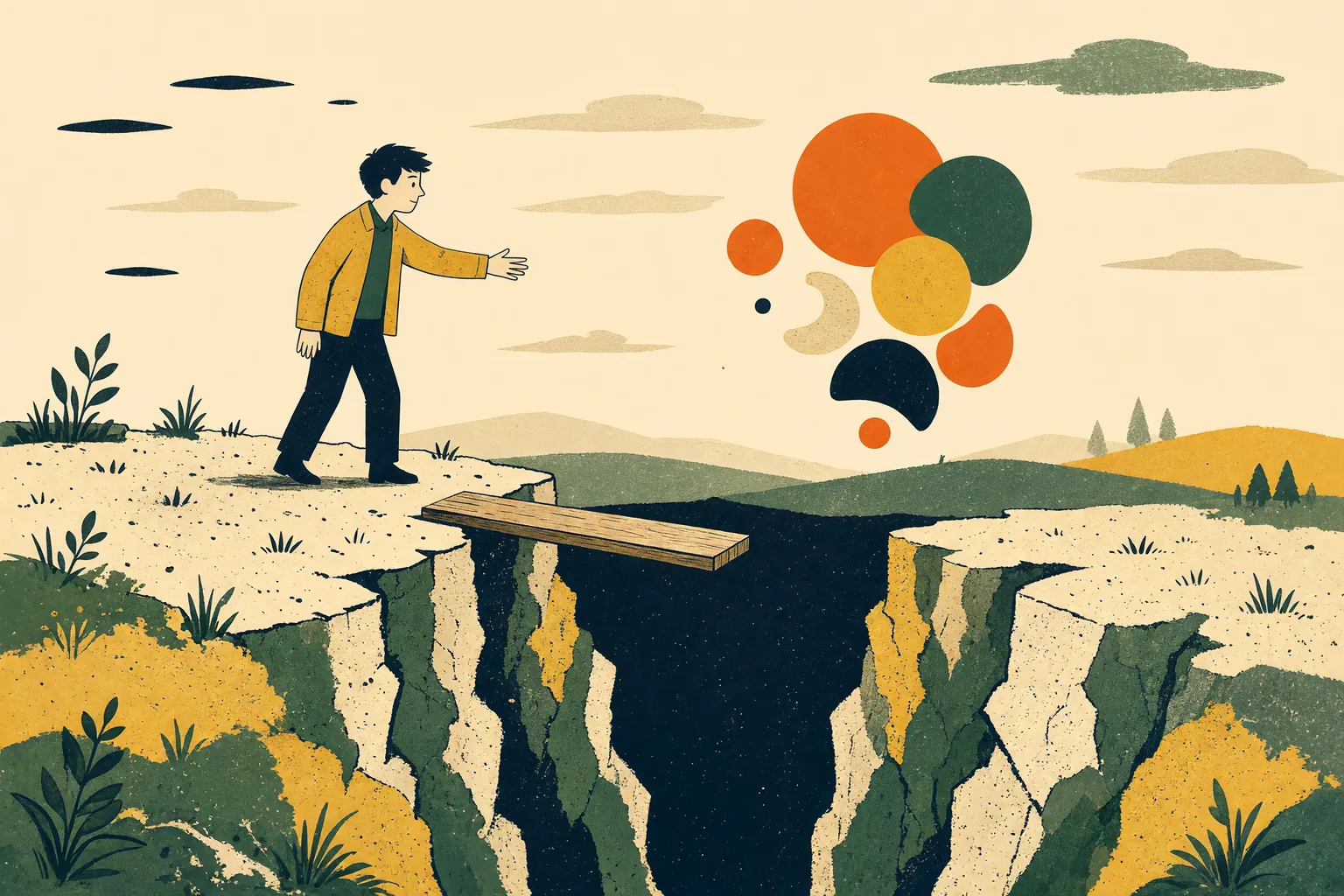
If you understand Spanish but can’t speak it, your knowledge is real. Recognizing words someone else supplied is a different skill from retrieving them yourself, arranging them, and saying them before the moment passes. The fix is not more vocabulary. It is eight minutes a day of recall that ends in a live exchange.
The solution is not to abandon listening or learn another thousand words. Keep the input, but add small daily tasks that force you to retrieve familiar Spanish and use it in a live exchange. Begin with scenes whose language you mostly understand already.
Why you understand Spanish but can’t speak it
When you hear “¿Quieres café?”, the situation, the speaker’s tone, and the word café all help you recognize the question. To ask it yourself later, you have to find quieres, choose the correct form, remember the word order, and say it without those clues.
This difference appears outside language learning too. You may recognize a person immediately but struggle to recall their name with no prompt. More recognition practice can make recognition fast while leaving recall slow.
That is why another episode of a Spanish series can feel comfortable but not change what happens at a café the next day. Listening supplies the line. Conversation waits for you to supply it.
You may know the words but not the whole phrase
Real speech is built from reusable pieces. A learner who knows poner, café, leche, and favor still has too many decisions to make at the counter. A speaker who has practiced “Me pones un café con leche, por favor” can retrieve the request as one unit and change only the drink.
Build a small bank of chunks for situations you use:
- Buenos días — Good morning
- Hola, ¿qué tal? — Hi, how are things?
- Bien, ¿y tú? — Good, and you?
- Perdona, ¿puedes repetir? — Sorry, can you repeat?
- Hasta luego — See you later
These are not a substitute for grammar. They give grammar somewhere to live. Once the frame is easy, you notice and change its parts with less pressure.
Why the words disappear in a real conversation
In a reading exercise, you can inspect the sentence. In conversation, you are also reading a face, listening to an accent, planning a reply, and wondering whether the other person understood. A word you recalled easily at home may disappear because your attention is divided.
This does not prove that you “do not know Spanish.” It shows that the language has not become easy to retrieve under those conditions yet.
Practice should gradually include the conditions you find difficult:
- A voice you did not script
- A short pause before you must answer
- A follow-up question
- Background sound
- A misunderstanding you have to repair
Do not add all of them on the first day. Learn a short exchange, then make one part less predictable each time you repeat it.
Fear of mistakes can block the first sentence
Sometimes the delay is not finding a word; it is checking every possible error before you let the word out. You start to build a sentence, reject it, replace the verb, check the ending, and miss the turn.
Set a different target for roleplay: reach the meaning with one clear sentence. If the sentence works, keep the conversation moving. Note one correction after the scene instead of correcting yourself five times during it.
You still need accuracy. The order matters. First complete the communicative task; then review the form; then run the task again. This keeps correction connected to language you actually needed.
If the physical feeling of freezing is the main problem, Why You Freeze When You Speak a Foreign Language gives you a smaller exposure plan.
Which part of speaking Spanish is stuck?
Try this with a thirty-second Spanish clip and transcript.
- Listen without reading. Can you explain the meaning?
- Read the transcript aloud. Can you produce the sounds at a steady pace?
- Hide it and repeat the idea in your own words. Can you retrieve the language?
- Answer one follow-up question about it. Can you respond rather than recite?
The first point where the task breaks tells you what to practice, and it is a more specific answer than what level am I in Spanish.
- If step 1 is hard, keep building listening comprehension and read how to get better at understanding spoken Spanish.
- If step 2 is hard, use slow repetition and shadowing.
- If step 3 is hard, practice recall from prompts.
- If step 4 is hard, add live or simulated turns.
“I can’t speak” is too broad to guide practice. “I understand the question but need twenty seconds to retrieve the answer” gives you a clear job.
An 8-minute daily routine for speaking Spanish
Use one real situation for a week. The first scene in Linguino’s Spanish path is a Madrid bakery: you walk in, greet the person behind the counter, answer a quick ¿qué tal?, and say goodbye. The language is basic, but live timing makes it useful.
Minute 1: retrieve three lines
Look only at the English cues and say the Spanish:
- Good morning → Buenos días
- Hi, how are things? → Hola, ¿qué tal?
- See you later → Hasta luego
Wait a few seconds before revealing an answer. That effort is the recall practice.
Minutes 2–3: shadow the reply
Listen to a short native model and speak with it. Copy the stress and joined sounds, not only the individual consonants. Repeat Bien, ¿y tú? until it comes out as a response rather than a translation exercise.
Minutes 4–6: run the bakery scene
Have a person or AI play the shopkeeper. Enter, greet them, answer one question, and leave. Ask the partner to stay in Spanish and keep the scene short.
This is what the scene sounds like at natural speed:
The Madrid bakery, start to finish
Buenos días.
Good morning.
Buenos días.
Good morning.
Hola, ¿qué tal?
Hi, how are things?
Bien, ¿y tú?
Good, and you?
Muy bien. ¿Qué te pongo?
Very well. What can I get you?
Perdona, ¿puedes repetir?
Sorry, can you repeat?
¿Qué te pongo?
What can I get you?
Una barra de pan, por favor.
A loaf of bread, please.
Aquí tienes. Un euro con veinte.
Here you go. One euro twenty.
Gracias. Hasta luego.
Thanks. See you later.
Hasta luego.
See you later.
On the second run, change the time of day or the exact greeting. The goal is not to recite a fixed script perfectly. It is to keep your footing when one detail changes.
Minute 7: repair something on purpose
Ask “Perdona, ¿puedes repetir?” even if you heard the line. Repair phrases need rehearsal before a stressful moment. Knowing that you can request a repeat lowers the cost of missing something.
Minute 8: keep one correction
Write down the single correction that would most improve the next run. Say the corrected line twice, then stop. A short, focused review is easier to use tomorrow than a page of red marks.
Do not make the scene harder too soon
A familiar scene can feel “too easy” because you recognize all its vocabulary. That is exactly where output work should begin. The challenge is producing the words on time, hearing the reply, and staying present.
Raise difficulty by changing one dimension:
- Use no written phrase card.
- Ask the other person to speak at a natural pace.
- Add one unexpected question.
- Change the location from a bakery to a café.
- Repeat the scene with a different voice or accent.
If everything changes at once, you cannot tell whether the problem is vocabulary, listening, or pressure.
Keep input, but make it feed output
You do not need to stop reading books, watching shows, or listening to podcasts. Turn a small piece of each session into speech.
After a video, summarize it aloud in three sentences. Choose one line and adapt it to your own life. Ask and answer a question that the scene raises, and stop translating the question before you answer. Send a thirty-second voice note instead of another text message.
At the end of a reading session, close the page and explain its main idea aloud. If the words vanish, reopen it, take one useful phrase, and try the summary again.
This is the bridge: input gives you material; retrieval and interaction teach you to use it.
For more exercises you can do without a partner, see How to Practice Speaking Spanish Alone. When you want a practical script, use the Spanish directions guide and prepare both the question and the reply.
Linguino is designed for this exact recognition-to-recall gap. Every scene becomes a live spoken lesson: the teacher gives you a small set of useful phrases, plays the other person, and adapts to your words while phrase cards, replay, and translation remain available. The quiz, scored speaking cards, coach notes, and Phrasebook then turn what happened in the conversation into focused review.
Start with hello and goodbye. If you can enter the bakery, answer one ordinary question, and leave in Spanish, the language is no longer only something you understand.