How to tell a story about your past in English
We were driving to the beach when suddenly the car broke down.
“We were driving to the beach when the car suddenly stopped working.”
When: The turning point of your story
The moment
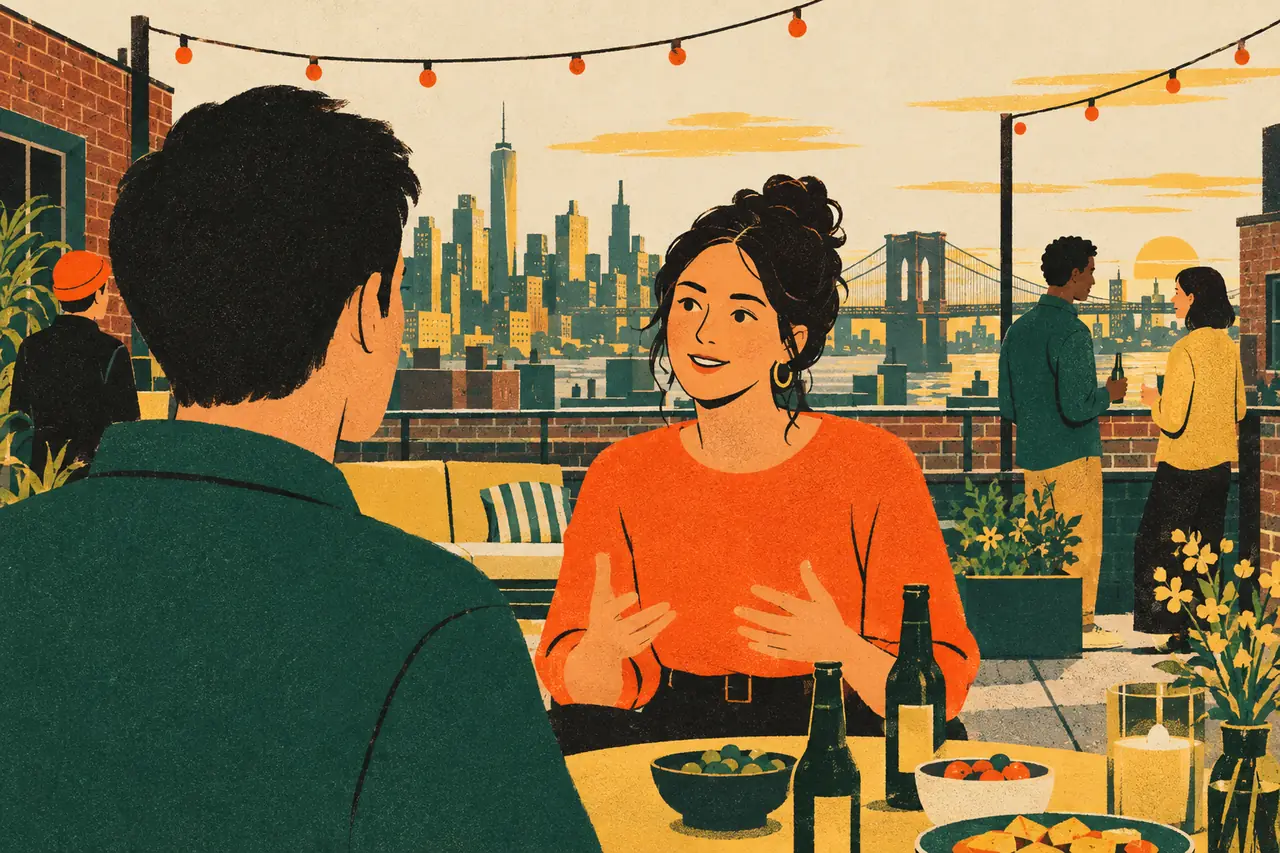
You're at a friend's rooftop party in Brooklyn and someone asks about the craziest trip you've ever taken. Tell the whole story so it keeps everyone hooked, from the setup to the ending.
B1 · Unit 2 · Stories & feelings
The lines
Scene first, then the twist
Set the scene with "was/were + -ing", then drop the big moment with the simple past after "when": "We were driving to the beach when suddenly the car broke down." The first part is the background. The second part is what happened.
We were driving to the beach when suddenly the car broke down.
“We were driving to the beach when the car suddenly stopped working.”
When to use it: The turning point of your story
What you’ll hear back: No way! What did you do? (Really? What happened next?)
Landing the ending
Americans close a story with "So long story short" and then the result: "So long story short, we ended up sleeping in the car." "Ended up" means this is how it finished, even if you didn't plan it.
So long story short, we ended up sleeping in the car.
“To tell the story quickly: in the end, we slept in the car.”
When to use it: The last line, once the story is told
What you’ll hear back: Oh my God, that's hilarious. (That's very funny.)
Words for this scene
| Word or phrase | Say it | Meaning |
|---|---|---|
| back when I lived in... | BAK wen ai LIVD in | at the time when my home was in... |
Back when I lived in Chicago, I took the train everywhere. When my home was in Chicago, I used the train to go everywhere. Tip: A classic story opener; it sets the time and place fast. | ||
| out of nowhere | OW-duh NOH-wair | very suddenly, with no warning |
Out of nowhere, this huge dog ran across the road. Suddenly, with no warning, a very big dog ran across the road. Tip: More vivid than "suddenly"; Americans use it in almost every story. | ||
| turns out | TURNZ OWT | later we learned that |
Turns out the guy at the gas station was the owner's brother. Later we learned that the man at the gas station was the owner's brother. Tip: Drop "it" in casual speech; it signals the surprise reveal. | ||
Your objective
Tell the story in order: where you were and what was happening, what suddenly went wrong, and how it ended.
- the setting
- what went wrong
- how it ended
Lines that get it done
- We were driving to the beach when suddenly the car broke down.
- Out of nowhere, this huge dog ran across the road. · Suddenly, with no warning, a very big dog ran across the road.
- So long story short, we ended up sleeping in the car.
In the live scene the objective stays on screen, and the Replay afterwards says whether you got it done.
Check yourself
1. You want to say the car broke down while you were in the middle of driving. What do you say?
- We were driving to the beach when suddenly the car broke down.
- We drove to the beach when suddenly the car was breaking down.
- We have driven to the beach when suddenly the car broke down.
- We were driving to the beach when suddenly the car was break down.
Show the answer
We were driving to the beach when suddenly the car broke down.
The background action takes "were driving" and the sudden event takes the simple past "broke down".
2. Your friend says, "So long story short, we ended up missing the flight." What does she mean?
- In the end, after all that, they missed the flight.
- She is going to tell a much longer story now.
- They almost missed the flight, but they caught it.
- They decided to miss the flight on purpose.
Show the answer
In the end, after all that, they missed the flight.
"Long story short" skips to the end, and "ended up" tells you the final result.
3. You want to reveal a surprise you only learned later. Which sounds most natural?
- Turns out the restaurant was closed the whole time.
- It turned the restaurant was closed the whole time.
- Out of turn, the restaurant was closed the whole time.
- It was turning out the restaurant closed the whole time.
Show the answer
Turns out the restaurant was closed the whole time.
"Turns out" (short for "it turns out") introduces a fact you discovered later.