Arriving late at a hotel in French, with a booking problem
Bonsoir, j'ai une réservation au nom de Lefèvre.
“Good evening, I have a booking under the name Lefèvre.”
When: The first thing you say at the desk
The moment
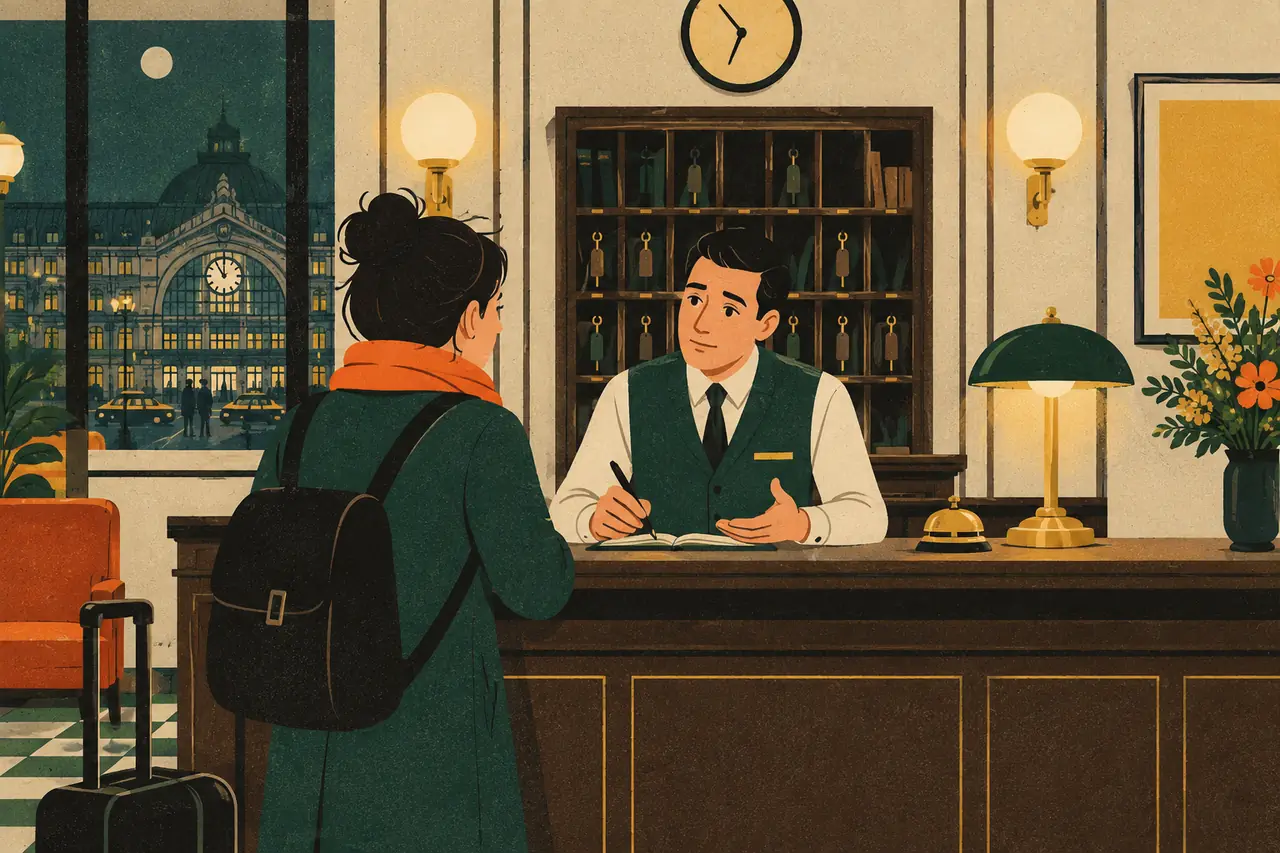
Your train arrives two hours late and you reach a hotel desk near Gare de Lyon around midnight, where the receptionist cannot find your booking. You explain what happened, flag the problem and negotiate somewhere to sleep.
A2 · Unit 2 · Travel days · Checkpoint
This is the unit’s checkpoint: one roleplay that puts the unit’s scenes together.
The lines
Announcing your booking
At midnight it is Bonsoir, never Bonjour, but the rest of the line never changes: "Bonsoir, j'ai une réservation au nom de Lefèvre." Greeting first, name after au nom de, then let them look.
Bonsoir, j'ai une réservation au nom de Lefèvre.
“Good evening, I have a booking under the name Lefèvre.”
When to use it: The first thing you say at the desk
What you’ll hear back: Je regarde tout de suite, un instant. (I'll check right away, one moment.)
Flagging the problem calmly
When the booking is wrong, name the problem without accusing anyone: "Il y a un problème avec ma réservation." It buys you a calm desk clerk and a solution.
Il y a un problème avec ma réservation.
“There's a problem with my booking.”
When to use it: The moment they say your room is gone
What you’ll hear back: Attendez, je vérifie dans le système. (Hold on, I'll check the system.)
Words for this scene
| French | Say it | English |
|---|---|---|
| à cause du retard | ah kohz dew ruh-TAR | because of the delay |
Je suis arrivé très tard à cause du retard du train. I arrived very late because of the train delay. Tip: Give the reason before you ask for anything; staff soften fast. | ||
| Je peux me faire rembourser ? | zhuh puh muh fair ron-boor-SAY | Can I get a refund? |
La chambre n'est plus disponible, je peux me faire rembourser ? The room isn't available any more, can I get a refund? Tip: Ask for a justificatif, a written note, for your travel insurance. | ||
| Vous pouvez me proposer autre chose ? | voo poo-VAY muh pro-poh-ZAY oh-truh SHOHZ | Can you offer me something else? |
Si la chambre est prise, vous pouvez me proposer autre chose ? If the room is taken, can you offer me something else? Tip: Never demand; asking what they can offer keeps the desk on your side. | ||
Your objective
Explain why you’re arriving so late, give the name on your booking, and when there’s a problem with it, agree on a room for tonight.
- why you’re late
- the name on your booking
- a room for tonight
Lines that get it done
- Je suis arrivé très tard à cause du retard du train. · I arrived very late because of the train delay.
- Bonsoir, j'ai une réservation au nom de Lefèvre.
- Vous pouvez me proposer autre chose ? · Can you offer me something else?
In the live scene the objective stays on screen, and the Replay afterwards says whether you got it done.
Check yourself
1. You arrive hours late and want to explain why. What do you say at the desk?
- Je suis arrivé très tard à cause du retard du train.
- J'ai arrivé très tard à cause du retard du train.
- Je suis arrivé très tard parce que le retard du train.
- Je suis arrivé très tard pour le retard du train.
Show the answer
Je suis arrivé très tard à cause du retard du train.
Arriver takes être in the past, and à cause de introduces the noun retard.
2. The receptionist says your room was given away. How do you flag it politely?
- Il y a un problème avec ma réservation.
- Il y a une problème avec ma réservation.
- C'est un problème de ma réservation.
- Ma réservation a un problème avec vous.
Show the answer
Il y a un problème avec ma réservation.
Problème is masculine, and il y a un problème avec is the standard way to raise an issue.
3. They finally give you a room, but there is no hot water. What do you say?
- Il n'y a pas d'eau chaude, je peux changer de chambre ?
- Il n'y a pas de l'eau chaude, je peux changer de chambre ?
- Il n'y a pas d'eau chaude, je peux changer la chambre ?
- Il n'y a pas d'eau chaude, vous changez ma chambre.
Show the answer
Il n'y a pas d'eau chaude, je peux changer de chambre ?
After a negative, de l' becomes d', and changer de chambre is how you ask to be moved.