How to book a table at a restaurant in French
Bonjour, je voudrais réserver une table pour deux, à vingt heures.
“Hello, I'd like to book a table for two at eight in the evening.”
When: Opening line on the phone or at the door
The moment
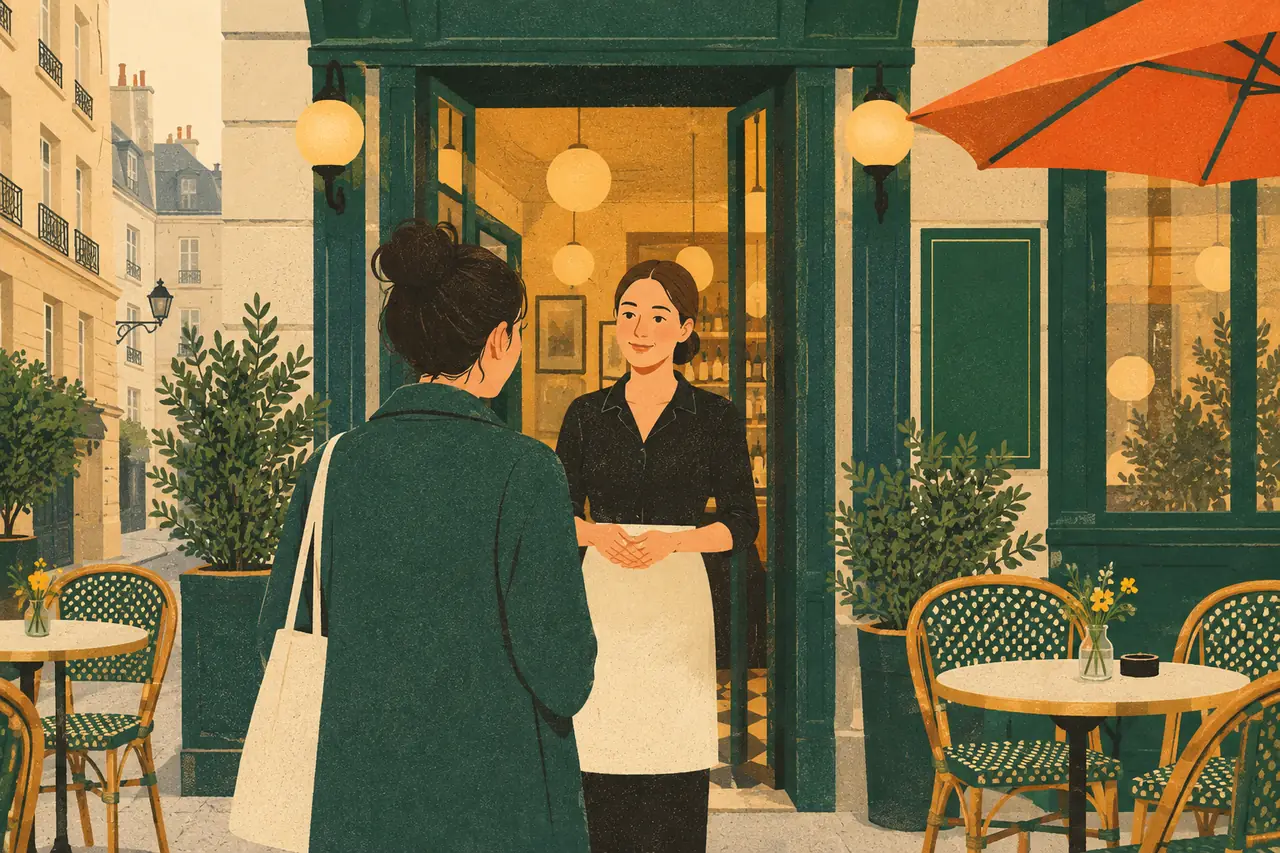
You call a small bistro in the Marais to book a table for two tonight, and you would much rather sit on the terrace.
A2 · Unit 1 · Eating out
The lines
The whole booking in one line
People, then time, wrapped in a soft request: "Bonjour, je voudrais réserver une table pour deux, à vingt heures." Je voudrais is what makes it polite; je veux sounds like an order.
Bonjour, je voudrais réserver une table pour deux, à vingt heures.
“Hello, I'd like to book a table for two at eight in the evening.”
When to use it: Opening line on the phone or at the door
What you’ll hear back: Oui, c'est à quel nom ? (Yes, under what name?)
Asking with vous auriez
For a preference you may not get, use the conditional: "Est-ce que vous auriez une table en terrasse ?" Vous auriez asks whether they might have one, so a no costs nobody anything. Swap en terrasse for à l'intérieur to sit inside.
Est-ce que vous auriez une table en terrasse ?
“Would you have a table outside on the terrace?”
When to use it: Right after they confirm the time
What you’ll hear back: Je vous mets en terrasse, pas de problème. (I'll seat you outside, no problem.)
Words for this scene
| French | Say it | English |
|---|---|---|
| On est complet | on-neh kom-PLEH | We're fully booked |
Désolé, on est complet jusqu'à vingt et une heures. Sorry, we're fully booked until nine. Tip: Complet is your cue to take a later slot, not to argue. | ||
| C'est au nom de Martin. | seh oh NOHN duh mar-TAN | It's under the name Martin. |
Une table pour deux à vingt heures, c'est au nom de Martin. A table for two at eight, it's under the name Martin. Tip: Spell your surname; they will ask you to repeat it. | ||
| Vous avez de la place ? | voo-zah-VAY duh lah PLASS | Do you have any room? |
Bonsoir, vous avez de la place pour trois, sans réservation ? Good evening, do you have room for three, without a booking? Tip: The walk-in line, and it comes after Bonsoir, never instead of it. | ||
Your objective
Book a table for tonight: give the number of people, a time and your name, and take another time if yours is full.
- the number of people
- a time
- your name
Lines that get it done
- Bonjour, je voudrais réserver une table pour deux, à vingt heures.
- C'est au nom de Martin. · It's under the name Martin.
In the live scene the objective stays on screen, and the Replay afterwards says whether you got it done.
Check yourself
1. You are calling a restaurant to book a table for two at 8 pm. What do you say?
- Bonjour, je voudrais réserver une table pour deux, à vingt heures.
- Bonjour, je voudrais commander une table pour deux, à vingt heures.
- Bonjour, j'ai réservé une table pour deux, à vingt heures.
- Bonjour, je voudrais une réservation de deux heures pour une table.
Show the answer
Bonjour, je voudrais réserver une table pour deux, à vingt heures.
Réserver is to book; commander is for ordering food, and j'ai réservé says the booking already exists.
2. On the phone the host says: "On est complet jusqu'à vingt et une heures." What does that mean?
- They are fully booked until 9 pm.
- They close at 9 pm.
- The kitchen only opens at 9 pm.
- They serve a set menu until 9 pm.
Show the answer
They are fully booked until 9 pm.
Complet means no free tables, so the earliest they can seat you is 9 pm.
3. You show up with two friends and no booking. What do you ask at the door?
- Bonsoir, vous avez de la place pour trois ?
- Bonsoir, vous êtes trois places libres ?
- Bonsoir, il y a de la place pour trois heures ?
- Bonsoir, vous avez une place de trois ?
Show the answer
Bonsoir, vous avez de la place pour trois ?
De la place pour trois is the set way to ask for room for three people; the others are not French.