Getting across the city by public transport in French
Un aller-retour pour Versailles, s'il vous plaît.
“A return ticket to Versailles, please.”
When: At the ticket window
The moment
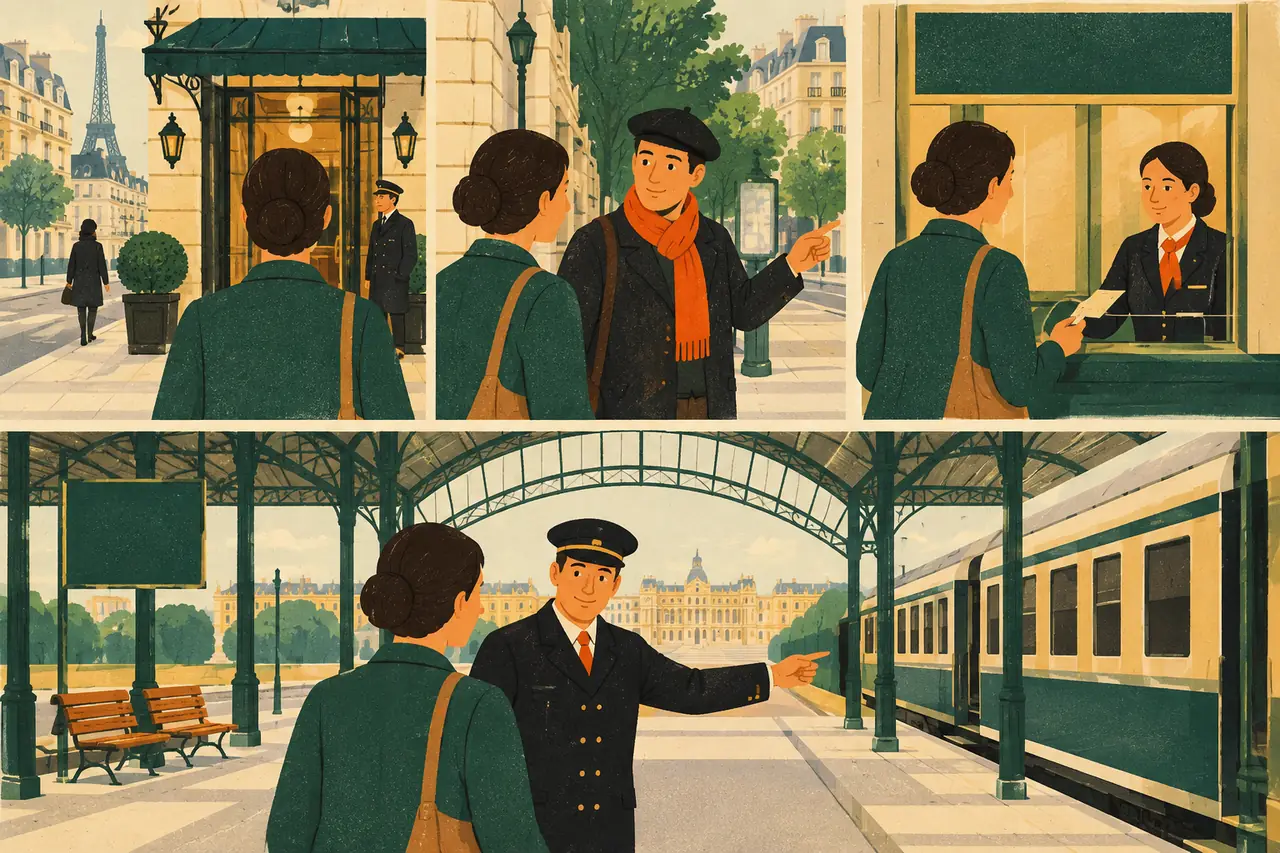
You leave your Paris hotel and have to reach the château de Versailles. You stop a passerby to ask which line to take, buy your ticket at the window, then check with someone on the platform that you are heading the right way.
A1 · Unit 3 · Getting around · Checkpoint
This is the unit’s checkpoint: one roleplay that puts the unit’s scenes together.
The lines
Buying the ticket
Same pattern as at the station: ticket type, "pour" plus destination, "s'il vous plaît". "Un aller-retour pour Versailles, s'il vous plaît." gets you there and back.
Un aller-retour pour Versailles, s'il vous plaît.
“A return ticket to Versailles, please.”
When to use it: At the ticket window
What you’ll hear back: Ça fait sept euros quatre-vingts. (That comes to seven euros eighty.)
Checking you are on the right side
"C'est bien...?" asks someone to confirm: "C'est bien la direction Versailles ?" Read the name off the platform sign and put it at the end.
C'est bien la direction Versailles ?
“This is the right direction for Versailles?”
When to use it: On the platform, before boarding
What you’ll hear back: Oui, c'est ça. (Yes, that's it.) or Non, c'est en face. (No, it's the other side.)
Words for this scene
| French | Say it | English |
|---|---|---|
| Quelle ligne je dois prendre ? | kel LEEN-yuh zhuh dwah PRAHNDR | Which line should I take? |
Pardon, pour aller à Versailles, quelle ligne je dois prendre ? Excuse me, to get to Versailles, which line should I take? Tip: Open with Bonjour or Pardon, or the answer comes back colder. | ||
| C'est quel quai ? | say kel KAY | Which platform is it? |
Le train pour Versailles, c'est quel quai ? The train to Versailles, which platform is it? Tip: Point at your ticket while asking; staff answer faster. | ||
| Il faut changer ? | eel foh shahn-ZHAY | Do I have to change? |
Pour aller au château, il faut changer ? To get to the château, do I have to change? Tip: The reply names the station: "changez à Invalides" means switch there. | ||
Your objective
Ask a passerby how to get there, buy your ticket, then check with someone on the platform that it’s the right train.
- how to get there
- your ticket
- checking it’s the right train
Lines that get it done
- Quelle ligne je dois prendre ? · Which line should I take?
- Un aller-retour pour Versailles, s'il vous plaît.
- C'est bien la direction Versailles ?
In the live scene the objective stays on screen, and the Replay afterwards says whether you got it done.
Check yourself
1. You are visiting Versailles and coming back to Paris tonight. Which ticket do you ask for?
- Un aller-retour pour Versailles, s'il vous plaît.
- Un aller simple pour Versailles, s'il vous plaît.
- Un billet double pour Versailles, s'il vous plaît.
- Deux allers pour Versailles, s'il vous plaît.
Show the answer
Un aller-retour pour Versailles, s'il vous plaît.
Aller-retour covers the trip there and back; aller simple is one way.
2. You are on the platform and want to check you are going the right way. What do you say?
- C'est bien la direction Versailles ?
- C'est loin, Versailles ?
- Vous allez à Versailles ?
- C'est quelle heure, Versailles ?
Show the answer
C'est bien la direction Versailles ?
"C'est bien...?" asks someone to confirm, and direction names where the line is heading.
3. You take a taxi back and want a rough price before setting off. What do you ask?
- C'est combien, à peu près ?
- C'est combien de temps ?
- Combien de temps, à peu près ?
- C'est cher, à peu près ?
Show the answer
C'est combien, à peu près ?
Combien asks the amount; the options with temps ask how long instead.