How to talk about holidays and traditions in Italian
Come si festeggia la festa del patrono qui da voi?
“How do you celebrate the patron saint's day here?”
When: Asking a local how their holiday actually works
The moment
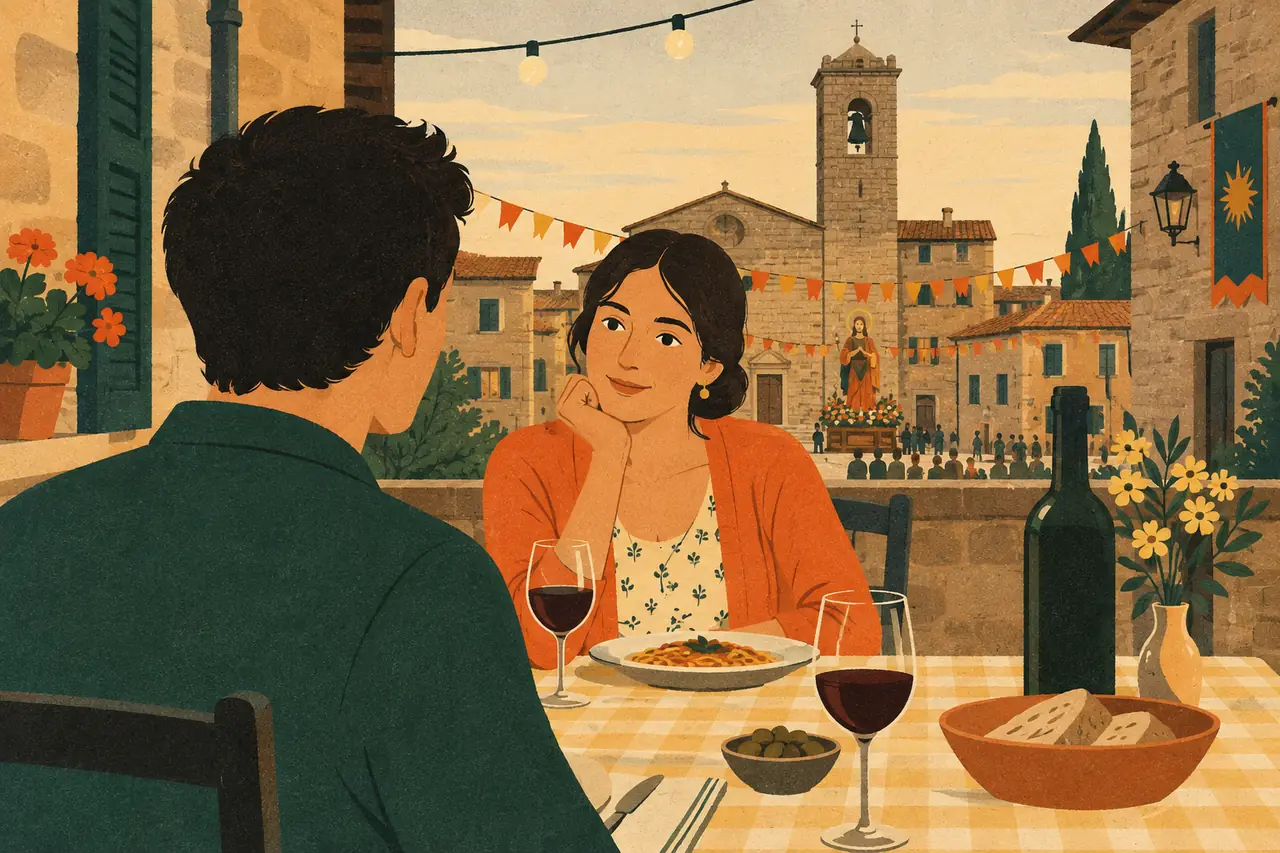
You are staying with friends in a small Umbrian town during the week of the festa del patrono. Over dinner you want to find out how the celebration works, describe a holiday from back home, and compare the two.
B1 · Unit 4 · Culture & conversation
The lines
Asking how it is done here
Customs are described with the impersonal 'si', so ask the same way: 'Come si festeggia la festa del patrono qui da voi?' The 'qui da voi' ('here where you are') makes it a warm local question rather than a survey.
Come si festeggia la festa del patrono qui da voi?
“How do you celebrate the patron saint's day here?”
When to use it: Asking a local how their holiday actually works
What you’ll hear back: Prima c'è la processione, poi si mangia tutti insieme in piazza. (First there's the procession, then everyone eats together in the square.)
Explaining a custom from home
'Da noi si usa' plus an infinitive is the set way to say 'where I'm from, the custom is to…': 'Da noi si usa passare tutta la vigilia a cucinare in famiglia.' It presents your tradition as a shared habit, not a personal quirk.
Da noi si usa passare tutta la vigilia a cucinare in famiglia.
“Where I'm from, the custom is to spend the whole day before the holiday cooking with the family.”
When to use it: Describing a holiday from your own country
What you’ll hear back: Ah, un po' come la nostra Vigilia di Natale. (Ah, a bit like our Christmas Eve.)
Words for this scene
| Italian | Say it | English |
|---|---|---|
| Che cosa si mangia di tipico? | keh KOH-zah see MAHN-jah dee TEE-pee-koh | What's the traditional dish? |
E per questa festa che cosa si mangia di tipico? And for this holiday, what's the traditional dish? Tip: Every festa has its one dish; asking counts as a compliment. | ||
| Assomiglia un po' a | as-soh-MEE-lyah oon POH ah | It's a bit like |
Assomiglia un po' al nostro Carnevale, ma senza maschere. It's a bit like our Carnival, but without costumes. Tip: Bridges two cultures without claiming they're the same thing. | ||
| C'è qualche sagra in zona? | cheh KWAL-keh SAH-grah een DZOH-nah | Is there a food festival nearby? |
Ad agosto c'è qualche sagra in zona? In August, is there a food festival nearby? Tip: Sagre celebrate one dish each; take cash, cards rarely work. | ||
Your objective
Ask how they celebrate it here, describe a holiday from your country, and say one way the two are alike or different.
- a question about the celebration
- a holiday from home
- a comparison
Lines that get it done
- Come si festeggia la festa del patrono qui da voi?
- Da noi si usa passare tutta la vigilia a cucinare in famiglia.
In the live scene the objective stays on screen, and the Replay afterwards says whether you got it done.
Check yourself
1. You want to know how the town celebrates its patron saint. What do you ask?
- Come si festeggia qui da voi?
- Quando si festeggia qui da voi?
- Chi festeggia qui da voi?
- Come vi festeggiate qui da voi?
Show the answer
Come si festeggia qui da voi?
'Come' asks how it's done and the impersonal 'si' means 'how do people celebrate'.
2. You want to say that back home people spend the whole day before Christmas cooking together. What do you say?
- Da noi si usa passare la vigilia a cucinare in famiglia.
- Da noi si usano passare la vigilia a cucinare in famiglia.
- Da noi si usa a passare la vigilia a cucinare in famiglia.
- Da noi si abitua passare la vigilia a cucinare in famiglia.
Show the answer
Da noi si usa passare la vigilia a cucinare in famiglia.
'Si usa' stays singular and takes a bare infinitive straight after it.
3. Their festival reminds you of Carnival back home, but not exactly. What do you say?
- Assomiglia un po' al nostro Carnevale, ma senza maschere.
- Assomiglia un po' il nostro Carnevale, ma senza maschere.
- Si assomiglia un po' del nostro Carnevale.
- È proprio la stessa identica cosa del nostro Carnevale.
Show the answer
Assomiglia un po' al nostro Carnevale, ma senza maschere.
'Assomigliare' takes 'a', and claiming the two are identical flattens the difference you were invited to notice.