How to talk about holidays and traditions in Japanese
このお祭りでは、どんなことをするんですか。
kono o-matsuri de wa, donna koto o suru n desu ka.
“What do people do at this festival?”
When: Asking a local about their festival or holiday
The moment
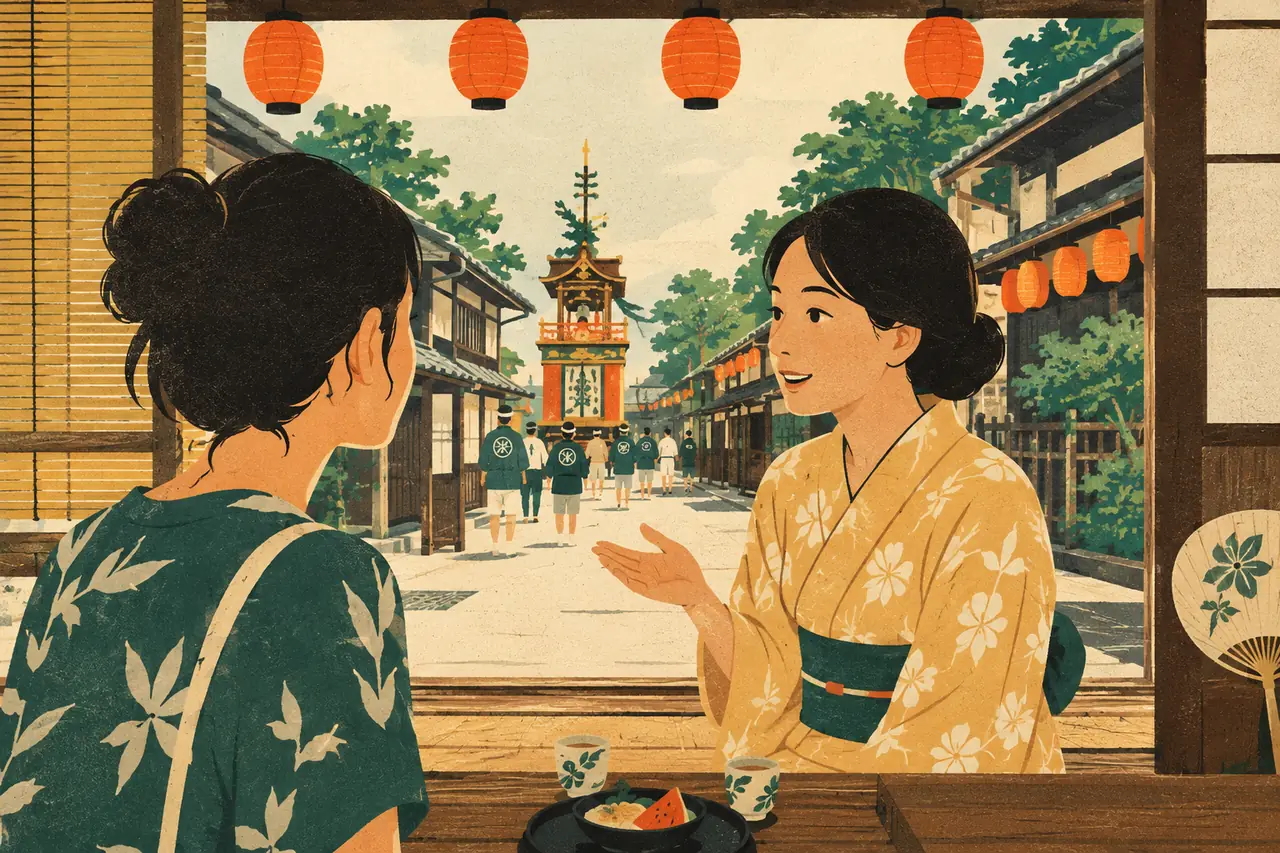
You are staying with a host family in Kyoto during the summer festival and your host is explaining what the neighbourhood does. You want to ask how it all works, describe a holiday from your own country, and compare the two.
B1 · Unit 4 · Culture & conversation
The lines
Asking how it's celebrated
Ask 「このお祭りでは、どんなことをするんですか。」 The 〜んですか ending signals real curiosity rather than a survey question, and どんなことをする asks about the customs themselves.
このお祭りでは、どんなことをするんですか。
kono o-matsuri de wa, donna koto o suru n desu ka.
“What do people do at this festival?”
When to use it: Asking a local about their festival or holiday
What you’ll hear back: みんなで神輿を担いで、そのあと屋台で食べたり飲んだりしますよ。 minna de mikoshi o katsuide, sono ato yatai de tabetari nondari shimasu yo. (Everyone carries the portable shrine, and then we eat and drink at the food stalls.)
Explaining your own custom
Use 「私の国では、〜んですよ」 to set your country as the scene: 「私の国では、クリスマスに家族で集まるんですよ。」 The 〜んですよ offers it as news your listener didn't have.
私の国では、クリスマスに家族で集まるんですよ。
watashi no kuni de wa, kurisumasu ni kazoku de atsumaru n desu yo.
“In my country, families get together at Christmas.”
When to use it: Describing a holiday from back home
What you’ll hear back: へえ、日本のお正月みたいですね。 hē, Nihon no o-shōgatsu mitai desu ne. (Oh, so it's like New Year in Japan.)
Words for this scene
| Japanese | Romaji | English |
|---|---|---|
| ちょっと似ていますね。 | chotto nite imasu ne | It's a bit similar, isn't it. |
うちの国の収穫祭と、ちょっと似ていますね。 It's a bit like the harvest festival back home, isn't it. Tip: 似ています beats 同じです; claiming they're identical sounds careless. | ||
| 一度見てみたいです。 | ichido mite mitai desu | I'd love to see it sometime. |
その花火大会、一度見てみたいです。 I'd love to see that fireworks festival sometime. Tip: Say it and a Japanese host will often invite you along. | ||
| そういう習慣はないんです。 | sō iu shūkan wa nai n desu | We don't have that custom. |
私の国にはそういう習慣はないんです。素敵ですね。 We don't have that custom in my country. It's lovely. Tip: Add the compliment straight after, or it lands as dismissive. | ||
Your objective
Ask how they celebrate it here, describe a holiday from your country, and say one way the two are alike or different.
- a question about the celebration
- a holiday from home
- a comparison
Lines that get it done
- このお祭りでは、どんなことをするんですか。
- うちの国の収穫祭と、ちょっと似ていますね。 · It's a bit like the harvest festival back home, isn't it.
In the live scene the objective stays on screen, and the Replay afterwards says whether you got it done.
Check yourself
1. You want to know what people actually do at the local festival. What do you ask?
- このお祭りでは、どんなことをするんですか。
- このお祭りは、どこでするんですか。
- このお祭りでは、何をしましたか。
- このお祭りを、どうしますか。
Show the answer
このお祭りでは、どんなことをするんですか。
どんなことをするんですか asks about the customs, and 〜んですか makes it sound genuinely curious.
2. You want to explain that back home families get together at Christmas. What do you say?
- 私の国では、クリスマスに家族で集まるんですよ。
- 私の国に、クリスマスに家族で集まります。
- 私の国では、クリスマスに家族を集めてください。
- 私の国は、クリスマスに家族で集まりたいです。
Show the answer
私の国では、クリスマスに家族で集まるんですよ。
〜では marks your country as the setting where the custom happens.
3. Your host describes a custom you have nothing like back home. What do you say?
- 私の国にはそういう習慣はないんです。素敵ですね。
- 私の国にはそういう習慣はいないんです。
- 私の国にそういう習慣は好きじゃないんです。
- そういう習慣、うちの国にはありません。つまらないですね。
Show the answer
私の国にはそういう習慣はないんです。素敵ですね。
Customs take ない, not いない, and the compliment keeps the remark warm.