Arriving late at a hotel in Spanish, with a booking problem
Tengo una reserva a nombre de García.
“I have a booking under the name García.”
When: Opening line at any reception desk
The moment
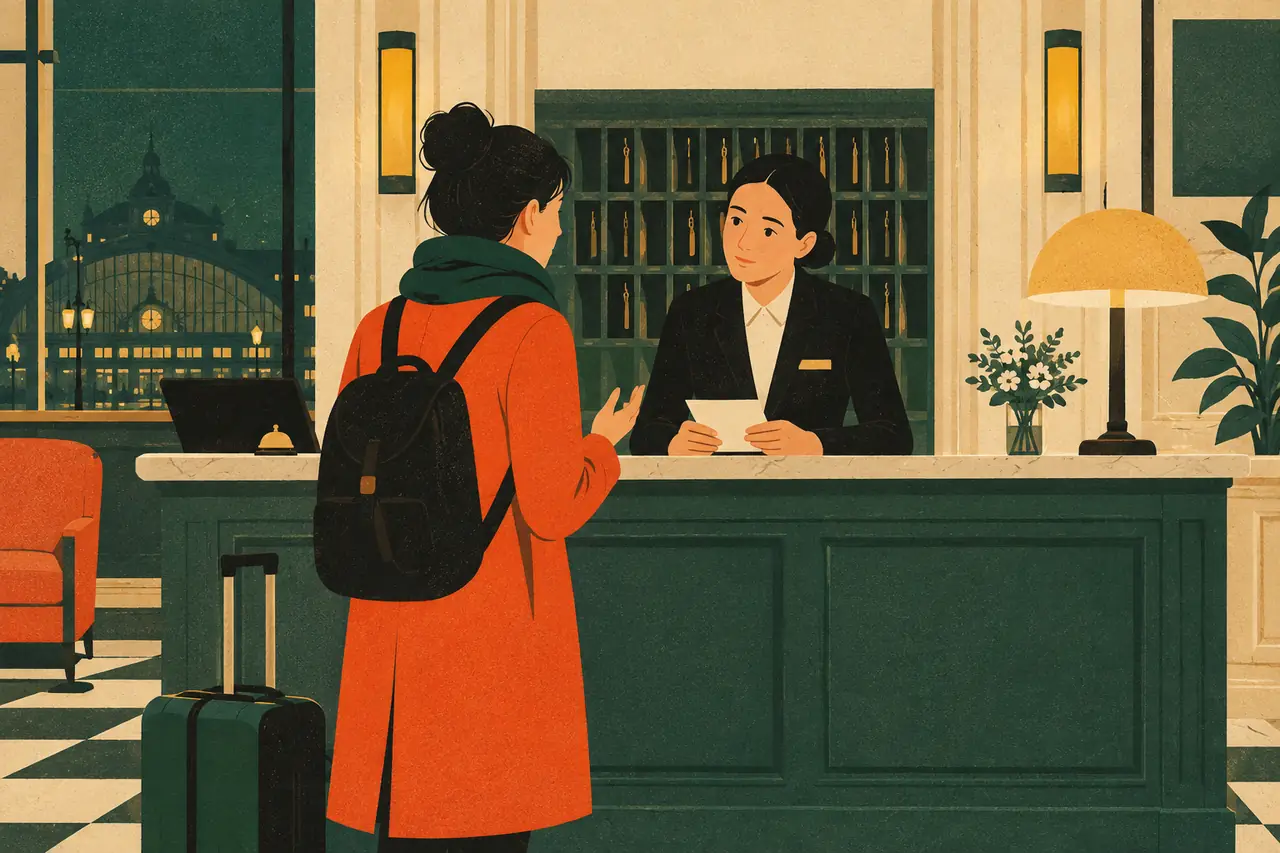
Your train from Barcelona reaches Madrid two hours late, so you arrive at your hotel near Atocha at midnight and the receptionist cannot find your booking. You explain what happened, claim your reservation, and negotiate a room for tonight.
A2 · Unit 2 · Travel days · Checkpoint
This is the unit’s checkpoint: one roleplay that puts the unit’s scenes together.
The lines
Claiming your booking
However badly the journey went, the desk conversation starts the same way: 'Tengo una reserva a nombre de García.' Say the name clearly and have your ID out.
Tengo una reserva a nombre de García.
“I have a booking under the name García.”
When to use it: Opening line at any reception desk
What you’ll hear back: Un momento, no la encuentro en el sistema. (One moment, I cannot find it in the system.)
Problem first, then the fix
One pattern covers a dead air conditioner, a cold flat or a broken lift: state the fault, then ask for the solution. 'No funciona el aire, ¿pueden cambiarme de habitación?'
No funciona el aire, ¿pueden cambiarme de habitación?
“The air conditioning isn't working. Could you move me to another room?”
When to use it: Any time something in your room or flat is broken
What you’ll hear back: Le doy otra habitación en la segunda planta. (I will give you another room on the second floor.)
Words for this scene
| Spanish | Say it | English |
|---|---|---|
| He perdido el enlace | eh per-DEE-doh el en-LAH-theh | I have missed my connection |
He perdido el enlace y llego a medianoche al hotel. I missed my connection and I am getting to the hotel at midnight. Tip: In Spain use the present perfect for anything that happened today. | ||
| ¿Cuál es la contraseña del wifi? | KWAL es lah kon-trah-SEH-nyah del WEE-fee | What is the wifi password? |
Perdone, ¿cuál es la contraseña del wifi de las habitaciones? Excuse me, what is the wifi password for the rooms? Tip: Reception often runs a different network from the rooms upstairs. | ||
| Se ha roto el grifo del baño. | seh ah RROH-toh el GREE-foh del BAH-nyoh | The bathroom tap has broken. |
Perdone, se ha roto el grifo del baño de mi habitación. Excuse me, the tap in my room's bathroom has broken. Tip: Blameless phrasing: in Spanish, things break by themselves. | ||
Your objective
Explain why you’re arriving so late, give the name on your booking, and when there’s a problem with it, agree on a room for tonight.
- why you’re late
- the name on your booking
- a room for tonight
Lines that get it done
- He perdido el enlace y llego a medianoche al hotel. · I missed my connection and I am getting to the hotel at midnight.
- Tengo una reserva a nombre de García.
- No funciona el aire, ¿pueden cambiarme de habitación?
In the live scene the objective stays on screen, and the Replay afterwards says whether you got it done.
Check yourself
1. The receptionist says your room was given away. How do you state your booking?
- Tengo una reserva a nombre de Ruiz.
- Tengo una reserva en nombre de Ruiz.
- Tengo una reserva con el nombre Ruiz.
- Soy la reserva a nombre de Ruiz.
Show the answer
Tengo una reserva a nombre de Ruiz.
The fixed expression is 'a nombre de', and you have a booking rather than being one.
2. Your train was cancelled. How do you ask what time the next one leaves?
- ¿A qué hora sale el siguiente?
- ¿Qué hora sale el siguiente?
- ¿A cuál hora sale el siguiente?
- ¿A qué hora salga el siguiente?
Show the answer
¿A qué hora sale el siguiente?
Departure times need 'a qué hora' plus the plain present 'sale'.
3. At the flat the next morning, how do you ask if electricity and water are included?
- ¿La luz y el agua están incluidas?
- ¿La luz y el agua son incluidas?
- ¿Hay la luz y el agua incluidas?
- ¿La luz y el agua están incluyendo?
Show the answer
¿La luz y el agua están incluidas?
Use 'estar' for the state of being included, agreeing with two feminine nouns.