How to Read Japanese: A Beginner's Guide
How to read Japanese as a beginner - hiragana, katakana and kanji, the sound rules that matter, and a Tokyo lunch order to read aloud with audio.
Linguino · Sep 23, 2026 · 9 min read
To read Japanese, start with hiragana, the 46 basic signs that spell every sound in the language. Then learn katakana, which spells the same sounds for words from other languages, and meet kanji one useful word at a time. Almost every kana stands for exactly one sound, so once you know them, you can sound out almost any word written in kana, even words you do not understand yet.
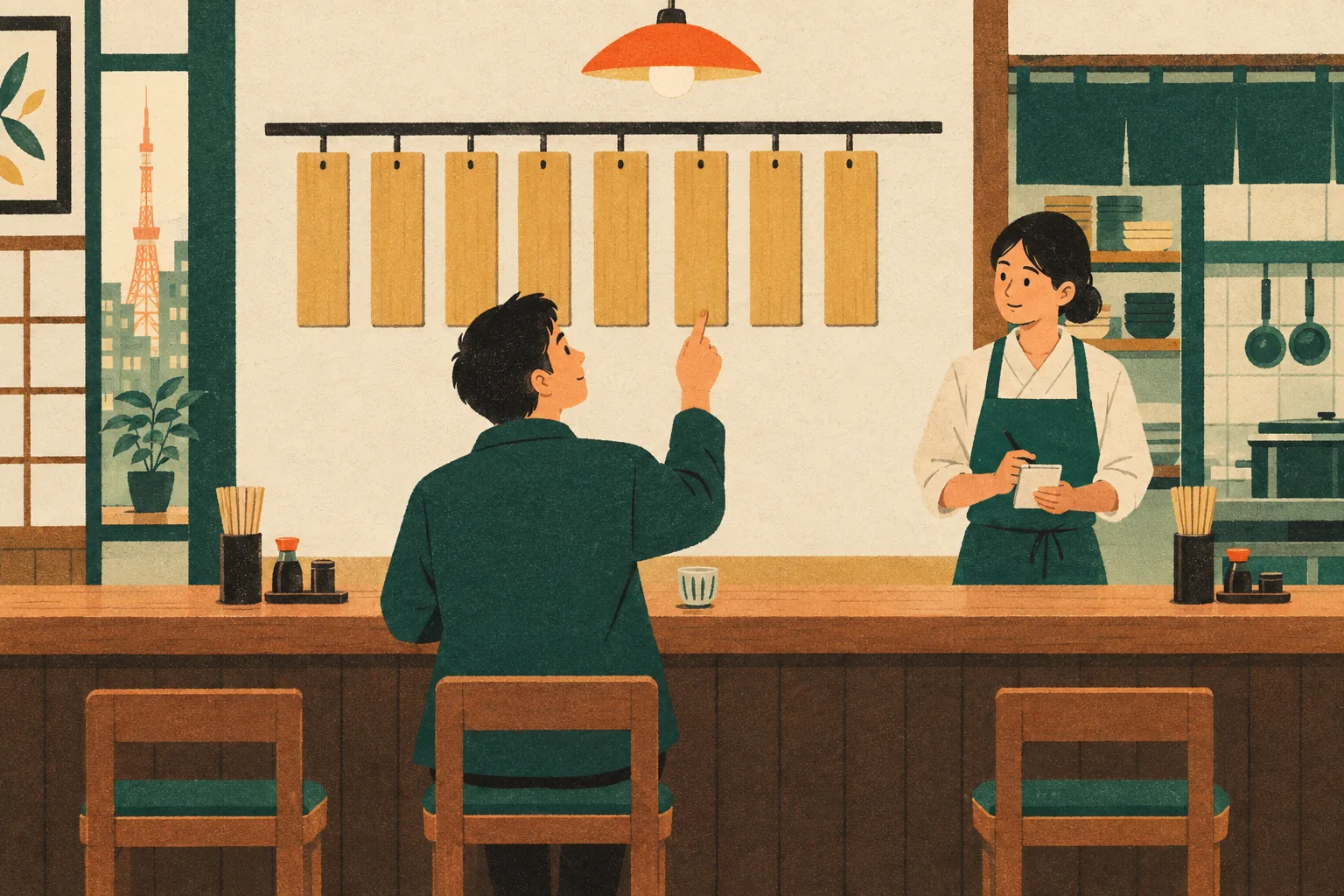
The hard part is that one Japanese sentence mixes all three scripts. Take this order from a Tokyo lunch shop: 親子丼とウーロン茶をお願いします。 It uses kanji for 親子丼 (oyakodon, a chicken-and-egg rice bowl), katakana for ウーロン (oolong), and hiragana for the small grammar words と and を and most of お願いします. This guide shows you how each script works, the reading rules that confuse beginners, and how to practice with a real menu.
How does the Japanese writing system work?
Japanese uses three scripts together, and each has a job. Once you can tell them apart, a line of text stops looking like one solid block.
| Script | Looks like | Main job | Example from a lunch shop |
|---|---|---|---|
| Hiragana | Round, curved lines | Grammar words, word endings, native words | と, を, おすすめ |
| Katakana | Straight lines, sharp corners | Words from other languages, foreign names | メニュー (menyū, menu) |
| Kanji | More strokes, one sign per idea | The core of most nouns and verbs | 定食 (teishoku, set meal) |
Japanese has no spaces between words. The change from one script to another often shows you where a word begins or ends: in メニューをお願いします, the katakana word ends where the hiragana を begins.
You may also see Japanese written in the Latin alphabet, called romaji. It helps at the start, and this guide uses it next to every example, but signs, menus and tickets in Japan are written in Japanese. Treat romaji as a support, not a replacement.
How to read hiragana: the sound rules that matter
Hiragana is a syllable chart. There are five vowels, a i u e o, and most other signs join a consonant to one of those vowels: か ka, き ki, く ku, け ke, こ ko. Japanese vowels stay short and clean. Say e as in "bed" and o as in "port", but shorter, without an extra glide at the end.
A few rules cover most of what a beginner will meet.
- Some signs break the pattern. し is shi, ち is chi, つ is tsu and ふ is fu. ん is a nasal n sound that takes a full beat of its own and never starts a word.
- Two small marks change a sound. Two short strokes (゛) make a sound voiced: か ka becomes が ga. You can see it in ひがわり (日替わり, higawari, "daily special"), where かわり changes to がわり inside the compound. A small circle (゜) turns h into p: は ha becomes ぱ pa.
- Small ゃ, ゅ, ょ join the sign before them. し + small ょ is しょ sho, one sound, as in 定食 (ていしょく, teishoku).
- A small っ doubles the next consonant. In the greeting you hear when you walk into a restaurant, いらっしゃいませ (irasshaimase, "welcome"), the small っ makes a short pause before sh.
- Long vowels are written out. おう and おお are usually a long ō, so 以上 (いじょう) is ijō. えい is usually said as a long ē, so ていしょく sounds like tēshoku.
- Three particles are read differently. は is read wa when it marks the topic, を is read o, and へ is read e when it means "to." In おすすめは何ですか, the は is wa.
You will also notice that です and します usually sound like des and shimas. The final u is so quiet it almost disappears. That is normal Tokyo speech, not a spelling mistake.
How to read katakana (and why the menu uses it)
Katakana spells the same sounds as hiragana with different shapes. You see it on menus for foreign food and drink, on signs for places like a hotel (ホテル) or a restroom (トイレ), and in foreign names. If you have read how to introduce yourself in Japanese, your name in Japanese is written in katakana, such as アレックス for Alex.
Katakana has one extra mark to learn: the long bar ー. It makes the vowel before it long. メニュー is menyū, and ウーロン茶 is ūroncha. When the text runs from top to bottom, the bar is written from top to bottom too.
Loanwords follow Japanese sounds, not the spelling of the original language, so the result can surprise you. The Agency for Cultural Affairs publishes the official guidance for writing loanwords in katakana. For reading, the practical tip is simple: sound the word out, then listen for the English, French or Chinese word inside it.
What about kanji? How many do you need?
Kanji are the characters that give Japanese text its dense look. The official list for general use, the Jōyō Kanji table from the Agency for Cultural Affairs, has 2,136 characters. You do not need that list to read a lunch menu. You need the words on the menu.
The main difficulty is that one kanji can have more than one reading. 日 is hi in 日替わり (higawari, "daily special"), ni in 日本 (Nihon, "Japan"), and part of 今日, which is read kyō, "today", as one word. No single character gives you that sound. This is why learning kanji inside words works better than learning each character alone.
Three tips help at the start.
- Look for small kana above or beside kanji. These are called furigana, and they show the reading. Children's books, some menus and many signs aimed at visitors use them.
- Learn kanji as whole words from real places. 定食 (teishoku, set meal) and 以上 (ijō, that's all) are more useful at the start than a list of single characters.
- Use the kana ending as a clue. In お待ちください, the kanji 待 carries the meaning "wait," and the hiragana after it carries the grammar.
Does Japanese have tones or accents?
Japanese does not have tones like Chinese, and the spelling never marks stress. It does have pitch accent: each word has a set pattern of high and low pitch. In Tokyo Japanese, 箸 (hashi, chopsticks) starts high and drops, while 橋 (hashi, bridge) starts low and rises. Both are written はし in hiragana.
You will rarely be misunderstood because of pitch, since context makes the meaning clear. The useful habit is to copy the audio of whole phrases instead of reading each sign flat.
Timing matters more for a beginner. Each kana gets about one beat (a small ゃ, ゅ or ょ shares the beat of the sign before it), and so do ん, small っ and the second half of a long vowel. おばさん (obasan, aunt) has four beats, and おばあさん (obāsan, grandmother) has five. If you shorten a long vowel, you can say a different word.
Which way do you read Japanese?
Japanese can run in two directions. Most signs, tickets and screens run left to right in lines, like English. Novels, manga, newspapers and many traditional menus run top to bottom, starting with the column on the right. A board at a small restaurant may use both: dish names written top to bottom, with other details written across.
If a text looks vertical, find the top of the rightmost column and read down.
Read a Tokyo lunch order aloud
These lines come from Linguino's "Ordering a meal" scene, set in a busy set-meal shop in Tokyo at noon. Cover the Reading column, read the Japanese aloud, then play the audio to check.
| Japanese | Reading | Meaning |
|---|---|---|
| すみません、メニューをお願いします。 | sumimasen, menyū o onegaishimasu | Excuse me, could I have the menu? |
| おすすめは何ですか。 | osusume wa nan desu ka | What do you recommend? |
| 日替わり定食 | higawari teishoku | The daily set meal |
| 親子丼とウーロン茶をお願いします。 | oyakodon to ūroncha o onegaishimasu | An oyakodon and an oolong tea, please. |
| 以上です。 | ijō desu | That's everything. |
| かしこまりました。少々お待ちください。 | kashikomarimashita. shōshō omachi kudasai | Certainly. One moment, please. |
Look for the rules from this guide in each line. を in the first line is read o, and は in the second is wa. 日替わり is read ひがわり, with the voiced が hidden inside the kanji 替. 以上 (いじょう) and 少々 (しょうしょう) have long vowels written with う, and ウーロン has the katakana bar. The last line is what the server says back, so it is worth recognizing even if you never say it.
Now hear the whole exchange. Read each line before you play it, then compare:
Ordering lunch at a Tokyo set-meal shop
いらっしゃいませ。
Welcome.
すみません、メニューをお願いします。
Excuse me, could I have the menu?
はい、どうぞ。
Here you are.
おすすめは何ですか。
What do you recommend?
今日は日替わり定食がおすすめです。
Today I recommend the daily set meal.
じゃあ、日替わり定食とウーロン茶をお願いします。以上です。
Then the daily set meal and an oolong tea, please. That's everything.
かしこまりました。少々お待ちください。
Certainly. One moment, please.
A 10-minute routine for reading Japanese out loud
- Pick three to five real items. Use a photo of a menu board, a station sign or a ticket, or the table above.
- Sort the scripts first. Mark which parts are kanji, which are hiragana and which are katakana. Read the kana parts aloud.
- Check the kanji readings. Look for furigana or check a dictionary, then write the reading in kana, not romaji.
- Read each line aloud, then play the audio. Listen for long vowels, the small っ pause and the quiet u in desu.
- Say the line once more without looking. Reading out loud and speaking from memory are different skills, and the second is the one you need at the table.
Reading is only one part of ordering lunch. The server will also answer you, and the guide to understanding spoken Japanese shows how to catch the reply. If you can read a line perfectly but you cannot think of the words when it is your turn to speak, see why you freeze when speaking a language.
In Linguino's lunch scene, your AI teacher plays the server at the set-meal shop and reacts to what you order. Every line you need appears on a phrase card with the Japanese script, a reading and the English meaning, and you can replay and translate the teacher's lines when the reply goes by too fast. Afterwards, a quiz, scored speaking cards, coach feedback and your Phrasebook help you review the words you read and said.