How to Understand Spoken Japanese as a Beginner
How to understand spoken Japanese: why it sounds fast, what to listen for, a 10-minute daily routine, and a live ticket-window scene to practice.
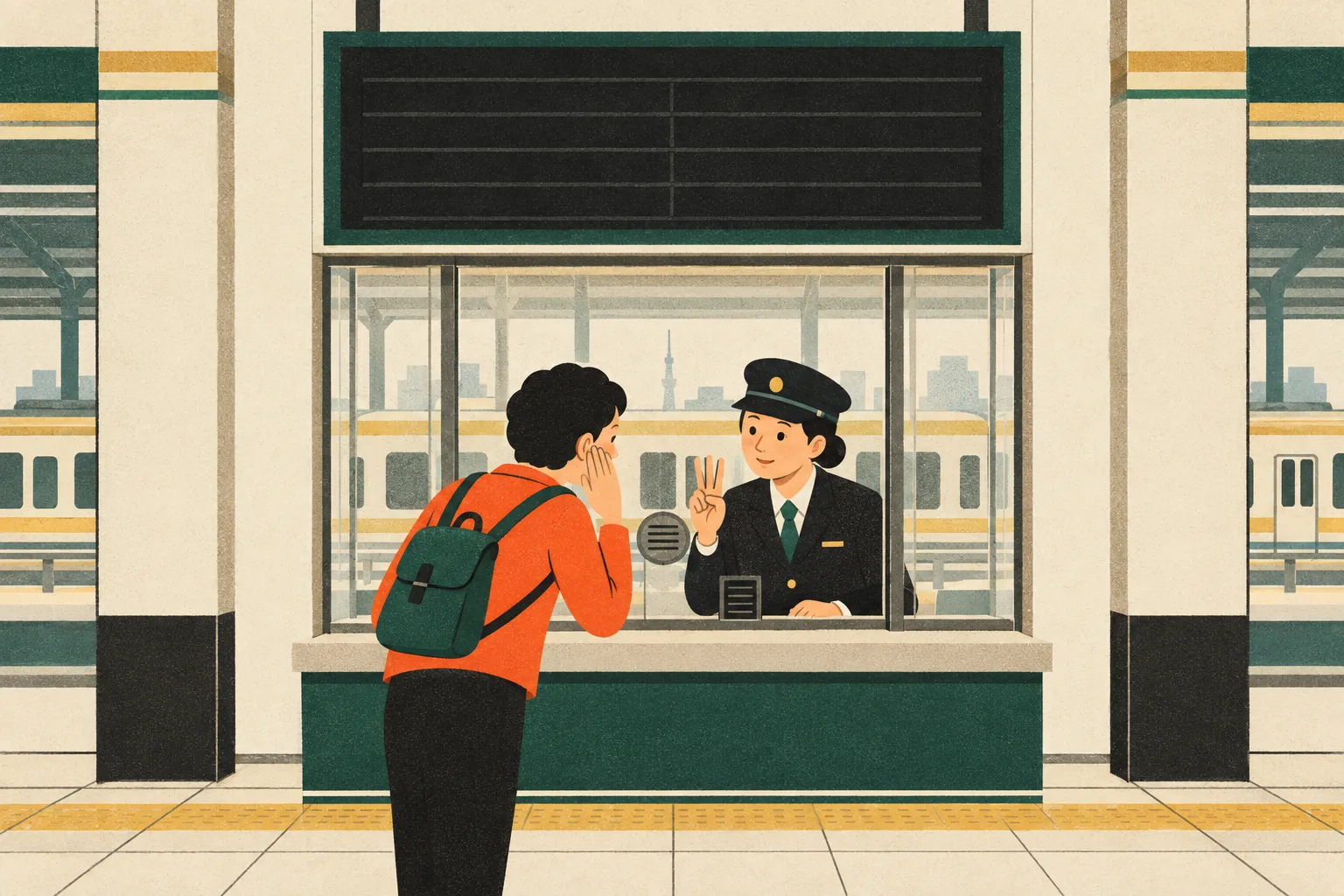
Linguino · Sep 23, 2026 · 9 min read
To understand spoken Japanese, start with short, predictable exchanges and listen for a few things you know will come: the place, the number, and how the sentence ends. Listen once for the situation, again for the details, then check the transcript and listen without it. Finish with a short conversation where you have to use what you heard.
You do not need every word. At a station ticket window in Tokyo, you need to hear whether the clerk confirmed your ticket, what it costs, what time the next train leaves, and which platform to go to. A ten-minute routine built around moments like that gives you a clearer task than "listen to more Japanese."
Is the problem listening, or reading?
Play a short Japanese clip, then look at its transcript. If you can read the transcript easily but the recording still sounds like one long stream, the work is connecting words you know to their spoken shapes. If the transcript is also hard, choose simpler material and learn the phrases first.
Many learners meet Japanese through writing, so a word can feel familiar on the page and still be new to the ear. If kana still slow you down, start with how to read Japanese. If you understand the other person but go silent when it is your turn, read about why you freeze when speaking. Here, we work on the step before your answer: hearing enough to know what the answer should be.
Why does spoken Japanese sound so fast?
Japanese can feel fast even when you know most of the words. Four features explain much of it.
1. Every beat gets about the same time
Japanese is timed in small beats called mora. か is one beat, but so is each ん in 何番線 (nanbansen) and the small っ in 切符 (kippu), "ticket." A long vowel counts as two beats.
This means length changes meaning. おばさん (obasan), "aunt," and おばあさん (obāsan), "grandmother," differ only by one held vowel. Many English speakers hear a long vowel or a pause as a small variation, but in Japanese it is a whole beat. When a phrase is too fast to follow, count the beats while you listen again.
2. Some vowels almost disappear
In Tokyo Japanese, the vowels i and u often become whispered or silent between sounds like k, s, t, h and p, and at the end of desu and -masu. です usually sounds like "des," 〜ました like "mashta," and in fast speech すみません can sound closer to "smimasen."
Listen for this in 往復ですね (ōfuku desu ne) . The u in fu and the final u in desu are hard to hear. If you wait for every vowel you saw in the romaji, you will think you missed a word.
3. Pitch, not stress, shapes each word
Japanese words rise and fall in pitch instead of hitting one syllable harder. The pattern can tell apart words written the same way in kana, and in a sentence the pitch tends to step down from phrase to phrase. You do not need to master this to understand a clerk, but it helps to know that the loud, stressed syllable you might listen for in English is usually not there.
The University of Tokyo's Online Japanese Accent Dictionary (OJAD) shows the pitch pattern of words and lets you hear them. Use it to check a word you keep missing.
4. The important part comes at the end
Japanese puts the verb at the end of the sentence, and small endings there change the meaning. ます means the verb is positive, ません turns it negative (行きます, "I go"; 行きません, "I don't go"). か makes a question. ね asks you to confirm. In everyday speech, even polite speech, forms also shorten: わかっています becomes わかってます, and では becomes じゃ.
So do not stop listening when you catch the place name or the number. Keep listening until the sentence is finished. The ending tells you whether you heard a statement, a question, or a negative.
Should you listen to slow Japanese or normal speed?
Slow audio helps you hear each beat, and it is fine to use it. But a very careful recording may pronounce vowels that normal speech whispers, so you get used to a version of Japanese you will rarely hear.
Once you understand a line slowly, play it again at normal speed. Then find someone else saying something similar. Understanding one recording after ten replays is practice; understanding a new speaker shows it is working.
For short, everyday recordings made for learners, NHK World's Easy Japanese has lessons with audio and scripts. Keep your clips to a minute or less. Long dramas and interviews can wait until you can follow more of a short clip without reading.
What should you listen for at a Japanese ticket window?
Before you press play, decide what you need to find out. At a station, you usually need four things: did the clerk confirm the ticket, how much, what time, and which platform.
Japanese makes this easier in one way: answers often repeat the shape of the question. Ask 何番線ですか (nanbansen desu ka), "Which platform is it?", and the answer is usually 三番線です (sanbansen desu). The number simply takes the place of 何 (nan), "what." Listen for the word that fills that gap.
Clerks also repeat your request back with ですね: "round trip, right?" This is a check, not a new question. A short はい (hai) confirms it.
Phrases for buying a train ticket in Japanese
These lines come from Linguino's "Buying a ticket" scene at Shinjuku Station, where you are going to Kamakura and coming back the same day. Readings use romaji; use the audio to hear which vowels fade.
| Japanese | Reading | Practical meaning |
|---|---|---|
| 鎌倉まで往復でお願いします。 | Kamakura made ōfuku de onegai shimasu | A round trip to Kamakura, please. |
| 片道 | katamichi | One way (use it in place of 往復). |
| 大人二枚お願いします。 | otona nimai onegai shimasu | Two adult tickets, please. |
| 次の電車は何時ですか。 | tsugi no densha wa nanji desu ka | What time is the next train? |
| 次は十時十五分です。 | tsugi wa jūji jūgofun desu | The next one is at 10:15. |
| 何番線ですか。 | nanbansen desu ka | Which platform is it? |
Numbers are where many learners get lost. Sounds change inside them: 三百 is sanbyaku, 六百 is roppyaku, and 八百 is happyaku. When you hear a price or a time, do not translate it digit by digit. Listen for the unit at the end, 円 (en), 時 (ji) or 分 (fun/pun), then go back to the number.
On the platform, you will also hear recorded announcements. This one is common:
まもなく、三番線に電車がまいります。
Mamonaku, sanbansen ni densha ga mairimasu.
"A train will soon arrive at platform 3."
まいります is a very polite form of "come," used in announcements. You do not need to use it. Just learn to hear まもなく ("soon") and the platform number.
A 10-minute daily routine for understanding spoken Japanese
Have a clip of up to one minute ready, with a transcript you can hide. Choose something where you already know much of the vocabulary. Use this one to start: hide the English, play it once for the situation, again for the details, then check only the lines you missed.
A round trip to Kamakura
すみません、鎌倉まで往復でお願いします。
Excuse me, a round trip to Kamakura, please.
鎌倉まで往復ですね。千九百四十円です。
A round trip to Kamakura, right? That's 1,940 yen.
はい。次の電車は何時ですか。
Yes. What time is the next train?
次は十時十五分です。
The next one is at 10:15.
何番線ですか。
Which platform is it?
三番線です。
Platform 3.
ありがとうございます。
Thank you.
Minutes 0–3: listen three times with three different tasks
On the first listen, name the situation. Who is speaking, and what do they want?
On the second, listen for two details: the time and the platform, for example. Do not stop for every unknown word.
On the third, focus on the one phrase that stopped you. Write the sounds you think you heard in kana or romaji, even if you cannot divide them into words. That gives you something specific to compare with the transcript.
Minutes 3–5: check the transcript and replay the difficult line
Read only the part you missed. Decide what happened: an unknown word, a vowel you expected but did not hear, a long vowel or small っ you did not count, a number that changed its sound, or an ending you stopped listening for.
Listen to that line while reading. Then hide the text and listen again. Say it once with the speaker, keeping the same rhythm. Keep only the one phrase you want to recognize tomorrow.
Minutes 5–8: use the situation in a live conversation
Have a partner or AI play the ticket clerk. Ask for your ticket, ask one practical question, and listen for the answer. Let the exact wording change.
If you miss something, say すみません、もう一度お願いします。 (Sumimasen, mō ichido onegai shimasu, "Sorry, once more, please."). In an app with replay and translation controls, listen again before you check the English. If you still cannot follow, read the meaning, then go back to the Japanese audio.
The conversation gives listening a purpose: you need the answer to decide what to say next.
Minutes 8–10: recall the exchange and choose tomorrow's phrase
Say what the clerk told you. English is fine for checking that you understood. Then say one useful line in Japanese without reading it.
Keep one phrase and one listening note: "I missed desu ne because the u was silent," or "I heard jūgofun only after I listened for fun." Start tomorrow by listening for that detail again.
How do you know your Japanese listening is improving?
After several days, go back to a similar task with a recording or conversation you have not memorized. Notice whether you catch the main point on the first listen, need fewer replays, or keep up after an unknown word instead of losing the next sentence.
Those changes tell you more than the minutes an app says you studied. If every new clip is still hard to follow, make the material easier. If you follow the sound but freeze before replying, practice a short, set exchange like introducing yourself in Japanese until you can hear the other person's reply coming. For a wider picture of what "understanding" means at each stage, see CEFR levels explained.
Linguino lets you replay your teacher's actual line and check its English translation inside the live conversation, so a missed reply becomes something you can practice straight away. Your AI teacher plays the ticket clerk and adapts to your answers, with phrase cards that show the Japanese, a reading and the meaning; the quiz, scored speaking cards, coach feedback and Phrasebook help you review afterwards. The ticket window is one of 52 scenes in each of seven language paths, with custom scenes for other situations and free three-minute sessions after email sign-in, no card required.