How to Order Coffee in French at a Café
How to order coffee in French: greet first, ask for the coffee you actually want, answer the server’s next question, and ask for the bill.
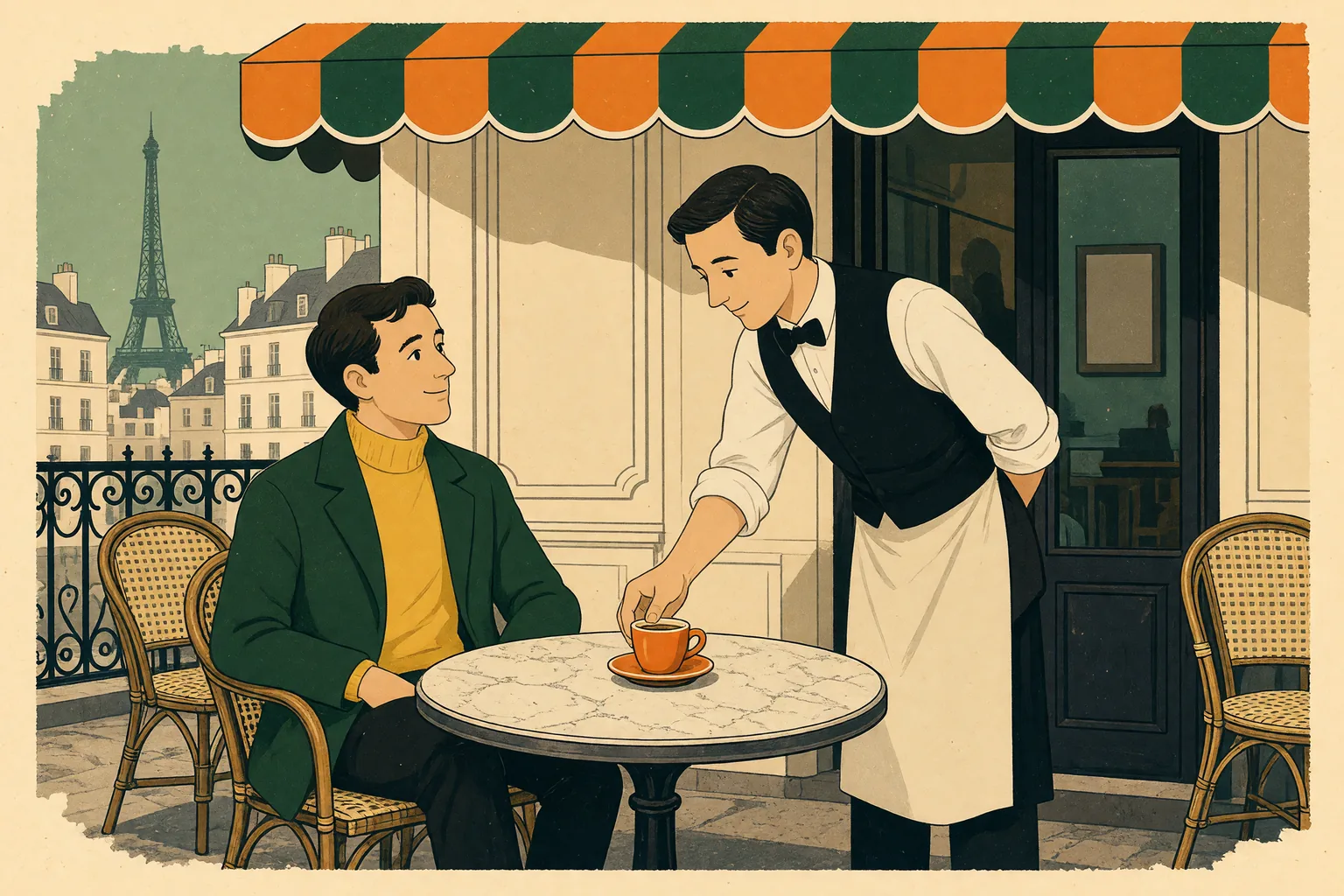
Linguino · Sep 3, 2026 · Updated Sep 9, 2026 · 6 min read
To order coffee in French, greet the server first and say “Bonjour, je voudrais un café, s’il vous plaît.” That means “Hello, I would like a coffee, please.” The greeting matters, and plain un café usually gets you an espresso rather than a large filter coffee.
The useful café script has four parts: greet, order the right drink, answer “Autre chose ?” (“Anything else?”), and ask for l’addition when you want to leave. Learn that exchange and you can handle a counter or terrace without translating every thought.
How to order coffee in French, line by line
| Moment | Say | Sounds like | Meaning |
|---|---|---|---|
| Begin | Bonjour. | bohn-ZHOOR | Hello / good day. |
| Order | Je voudrais un café, s’il vous plaît. | zhuh voo-DREH uhn kah-FEH seel voo PLEH | I would like a coffee, please. |
| Choose a longer coffee | Un café allongé, s’il vous plaît. | uhn kah-FEH ah-lon-ZHEH seel voo PLEH | A long black coffee, please. |
| Hear the follow-up | Autre chose ? | OH-truh shohz | Anything else? |
| Ask for the bill | L’addition, s’il vous plaît. | lah-dee-SYON seel voo PLEH | The bill, please. |
You can use the table as a complete scene. The server does not need a speech; one clear sentence is enough.
Say “bonjour” before the order
In a French shop, bakery, bar, or café, bonjour is not decoration. It recognizes the person before you ask them to serve you. Starting with the product alone—Un café—can sound sharp even if your pronunciation is excellent.
Use bonjour during the day and bonsoir in the evening. If you are unsure whether the evening has begun, follow what the staff say. Add s’il vous plaît to the request and merci when they bring it.
This small structure works well:
Bonjour + je voudrais + order + s’il vous plaît.
Keep it as one pattern and replace the order. You can ask for a coffee, tea, croissant, or glass of water without rebuilding the sentence.
“Je voudrais,” not “je veux”
Je voudrais means “I would like.” It is the normal polite form for ordering. Je veux means “I want.” It is correct French, but too direct for a routine order when you say it to a server.
You may also hear customers say Je vais prendre… (“I’ll have…”) or simply name the item after a greeting. As a learner, je voudrais is reliable and easy to reuse.
Do not let the French r delay the whole sentence. A clear rhythm and the polite frame do more work than one perfect sound.
What “un café” gets you, and which coffee to ask for
In France, un café is normally a small espresso. Order more precisely if you want something else:
- un café allongé — an espresso lengthened with more water
- un café crème — coffee with steamed milk or cream, with details varying by café
- un déca — a decaf coffee
- un thé — tea
If you want something closer to a long black coffee, un café allongé is the useful line in Linguino’s Paris scene. If you want milk, ask what the café calls its milk coffee rather than assuming the size from home.
The server may repeat your order as a question. A simple oui, merci confirms it.
At the counter, at a table, or to go
At a small coffee bar, you may order at the counter. At a traditional café terrace, sit down and wait for a server unless a sign tells you otherwise. The same polite order works in both places, and the same frame carries over to ordering in French at a restaurant, bakery, or bar.
For takeaway, say à emporter (“to take away”). For here, say sur place. You may hear:
Sur place ou à emporter ?
“For here or to take away?”
Answer with the two useful words and s’il vous plaît. If you are sitting on a terrace, the situation already answers the question.
What the server may say next
Prepare the reply, not only your first sentence. Common questions include:
- Autre chose ? — Anything else?
- Et avec ceci ? — Anything with that? / What else?
- Sur place ou à emporter ? — For here or to take away?
- Vous désirez ? — What would you like?
For Autre chose ?, say Non, merci if the order is complete. To add a croissant, say Et un croissant, s’il vous plaît.
If you miss the question, use Pardon, vous pouvez répéter ? (“Sorry, can you repeat?”). A server may shorten or rephrase it. That repair line is more useful than pretending you understood and receiving the wrong order.
How to ask for the bill in French
On a terrace, the server will not always bring the bill as soon as you finish. When you are ready, catch their attention and say:
L’addition, s’il vous plaît.
That is the whole request. L’addition means the bill in a restaurant or café. La facture is an invoice or formal bill, not the usual word for this moment.
You may hear Tout de suite (“right away”) in response. Depending on the café, you may pay at the table or take the bill inside. If you need to ask whether you can pay by card, say Je peux payer par carte ?
Put the phrases into one exchange
Server: Bonjour, vous désirez ?
You: Bonjour, je voudrais un café allongé, s’il vous plaît.
Server: Autre chose ?
You: Non, merci.
Later, you: L’addition, s’il vous plaît.
Server: Tout de suite.
The whole terrace exchange
Bonjour, vous désirez ?
Hello, what would you like?
Bonjour, je voudrais un café allongé, s'il vous plaît.
Hello, I would like a long black coffee, please.
Autre chose ?
Anything else?
Non, merci.
No, thank you.
L'addition, s'il vous plaît.
The bill, please.
Tout de suite.
Right away.
Read it once. Then cover your lines and respond only when you see the server’s prompt. Finally, say it aloud with some background noise. Real cafés do not wait in silence while you remember a phrase.
For the Spanish version of the same scene, compare how to order coffee in Spanish. The words differ, but the useful practice is identical: learn the opener and the next question. If speaking makes you anxious even with the lines in front of you, read why you freeze and how short roleplays help.
Linguino lets you practice this exact Paris terrace scene as a live conversation. The AI teacher first gives you the key phrase, then becomes the server and responds to your order. Phrase cards stay on screen, and you can use replay and translation for anything you missed before the quiz and scored speaking cards at the end.
Do not try to master every French drink name. Greet the server, order the coffee you want, answer one follow-up, and ask for the bill. That is the conversation you need.