How to Order Coffee in Spanish: Phrases for Spain
How to order coffee in Spanish: the exact line to say at a counter in Spain, what the barista asks back, and how to practice the whole exchange.
Linguino · Sep 3, 2026 · Updated Sep 9, 2026 · 6 min read
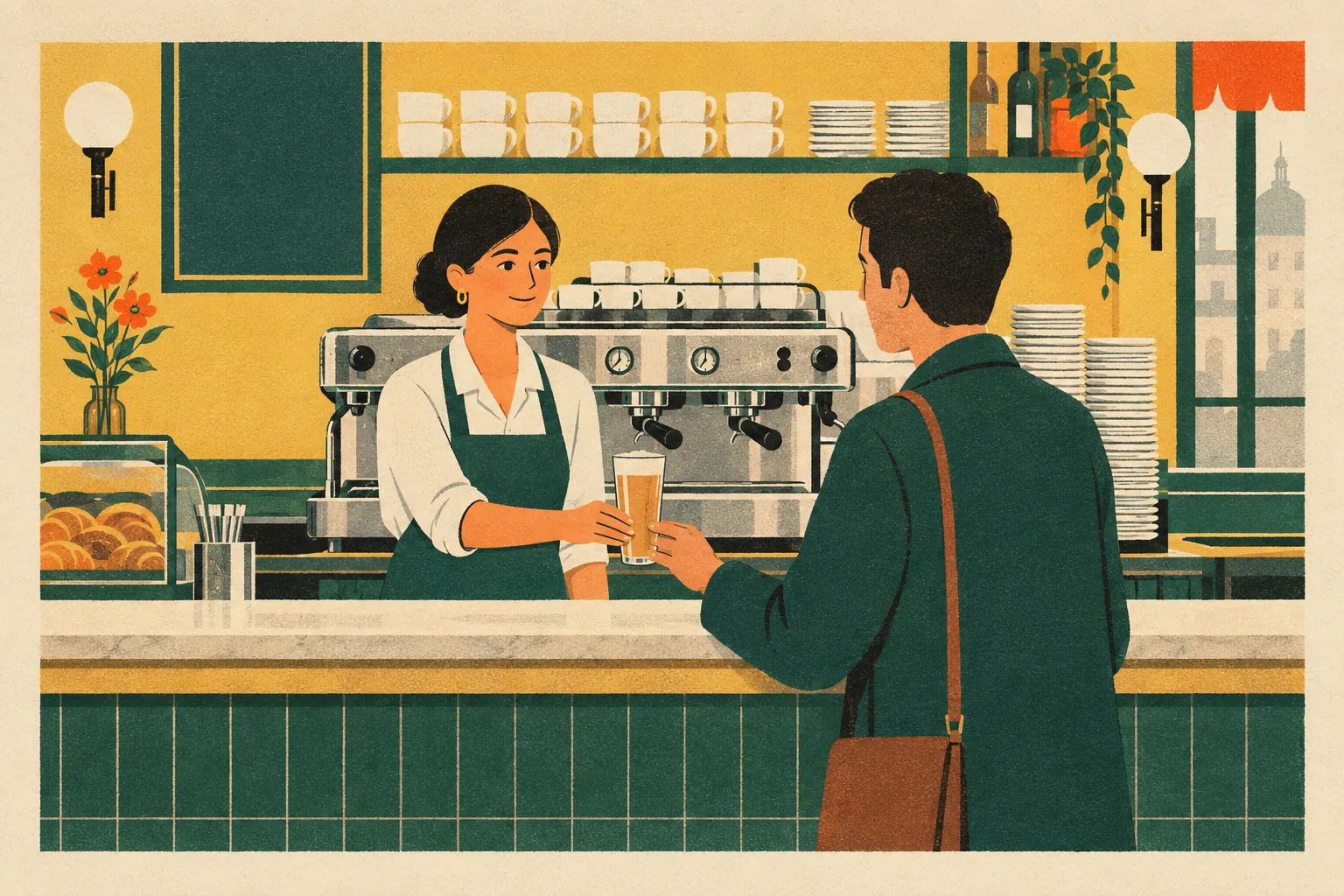
To order coffee in Spanish, greet the person and say “Me pones un café con leche, por favor”: “Can I get a coffee with milk, please?” That is how it sounds at a counter in Spain. In most of Latin America you would say “¿Me da un café con leche, por favor?” instead.
That first line gets you most of the way. The harder part is hearing the next question, adding a pastry or a takeaway cup, and asking to pay while the café is busy. Learn the exchange as a small scene and you will not have to build every sentence from scratch.
How to order coffee in Spanish in five lines
Here is the short version to practice before you go:
| Moment | Say | Sounds like | Meaning |
|---|---|---|---|
| Order | Me pones un café con leche, por favor. | meh POH-ness oon kah-FEH kon LEH-cheh | Can I get a coffee with milk, please? |
| Take it with you | ¿Me lo pones para llevar? | meh loh POH-ness PAH-rah yeh-VAR | Can you make it to go? |
| Hear the follow-up | ¿Algo más? | AL-goh mahs | Anything else? |
| Finish the order | Nada más, gracias. | NAH-dah mahs, GRAH-syahs | Nothing else, thank you. |
| Pay at the counter | ¿Me cobras, por favor? | meh KOH-brahs por fah-BOR | Can you charge me, please? |
Tap the buttons to hear each line, then say the whole exchange once without stopping. It matters more than saying each word perfectly in isolation.
Why “me pones” works in Spain
Me pones… literally looks like “you put me,” but that is not how a person in Madrid hears it. At a bar or café counter, it is an ordinary, friendly way to ask for something. Add por favor and use a calm tone.
You may also hear Quería un café con leche (“I wanted a coffee with milk”). This is polite too. For a first trip, choose one opening and make it automatic. A familiar sentence will come out more easily when three people are waiting behind you. If the trip is close, a two-week speaking plan for Spain puts this café on day four.
Avoid a bare Quiero un café if you are trying to sound warm. It is grammatically correct, but “I want a coffee” can sound too direct when said without a greeting or por favor. You do not need formal language; you just need the small signs of politeness that make an order feel human.
Which coffee should you ask for?
In Spain, un café usually means a small espresso. If that is not what you want, name the drink.
- Un café con leche is coffee with plenty of milk, often served in a cup or glass.
- Un cortado is espresso “cut” with a smaller amount of milk.
- Un café solo makes the espresso request explicit.
- Un descafeinado is decaf. The server may ask whether you want it de máquina (from the espresso machine) or de sobre (from a packet).
You do not need to memorize the whole menu. Pick the drink you actually order at home, learn its Spanish name, and put it into the same sentence: Me pones un cortado, por favor.
How to order coffee to go in Spanish
Say para llevar if you want the drink to go. In many cafés, staying is the assumed choice unless you say otherwise. The server may ask ¿Para tomar aquí o para llevar?: “For here or to take away?”
Your answer can be very short:
- Para llevar, por favor — To take away, please.
- Para tomar aquí — To have here.
If you already have the drink in your order, ¿Me lo pones para llevar? means “Can you make it to go?” The small word lo stands in for the thing you just ordered. Do not pause to explain the grammar at the counter. Treat the full sentence as one usable piece.
What the barista will say back
Many learners prepare their line but not the reply. That is why a successful first sentence can still end in silence.
The most likely question is ¿Algo más? (“Anything else?”). If you want a pastry, add Y un croissant, por favor . If not, say Nada más, gracias.
You may also hear:
- ¿Solo o con leche? — Black or with milk?
- ¿Aquí o para llevar? — Here or to go?
- Son tres euros — That is three euros.
- ¿Efectivo o tarjeta? — Cash or card?
Listen for the choice words: leche, aquí, llevar, efectivo, tarjeta. You do not need to catch every sound to answer correctly — that habit is also how you learn to follow the barista’s reply without translating it.
If the reply comes too quickly, say Perdona, ¿puedes repetir? (“Sorry, can you repeat?”). Asking for a repeat is part of speaking the language, not a failure to speak it, and getting better at understanding spoken Spanish means you will need it less often.
How to ask for the bill in Spanish
At a table, La cuenta, por favor is the standard request for the bill. At a counter in Spain, ¿Me cobras, por favor? is very common. It means “Can you charge me?” and tells the server you are ready to pay.
Use the phrase that matches where you are:
- At the counter: ¿Me cobras, por favor?
- At a table: La cuenta, por favor.
Then be ready for ¿Efectivo o tarjeta? If you are paying by card, the complete answer can be Con tarjeta, por favor .
Practice the exchange, not a word list
Reading the table helps you recognize the phrases. It does not fully prepare you to answer when another voice interrupts, changes the question, or waits for you.
Try this three-pass practice:
- Read the five-line exchange aloud slowly.
- Cover the English column and say each line from the situation alone.
- Run the café as a roleplay. Let the other person ask ¿Algo más? before you answer.
Listen to the whole exchange first, then run it with the English hidden:
The whole café exchange
Buenos días, ¿qué te pongo?
Good morning, what can I get you?
Buenos días. Me pones un café con leche, por favor.
Good morning. Can I get a coffee with milk, please?
¿Aquí o para llevar?
Here or to go?
Para llevar.
To go.
¿Algo más?
Anything else?
Nada más, gracias. ¿Me cobras, por favor?
Nothing else, thanks. Can you charge me, please?
Claro. Son dos euros con veinte. ¿Efectivo o tarjeta?
Sure. That's two euros twenty. Cash or card?
Con tarjeta, por favor.
By card, please.
If speaking still makes you stop, the guide to practicing Spanish when you are alone gives you several ways to build daily output. If you often know the answer but cannot produce it in time, read why understanding Spanish and speaking it are separate skills.
Linguino turns this exact Madrid café exchange into a live spoken lesson. Your AI teacher briefs you, gives you the key phrase, then plays the barista and responds to what you actually say; phrase cards and translations stay available when you need help. After the scene, a short quiz and speaking cards save the useful lines to your Phrasebook.
Start with one goal: order the coffee, answer ¿Algo más?, and pay. That is a complete real-world conversation.