Ordering in French: Restaurant, Bakery and Bar Phrases
Ordering in French at a restaurant, a bakery or a bar: the phrases to say, the questions you will hear back, and how to ask for the bill.
Linguino · Sep 8, 2026 · Updated Sep 9, 2026 · 6 min read
Ordering in French works from one frame: greet the person serving you, then say “Je vais prendre…” followed by the item and “s'il vous plaît.” It means “I'll have… please.” In a restaurant, a bakery, or a bar, that frame gives you a polite way to choose something without building a long sentence.
Prepare the reply as well as the order. “Et comme boisson ?” asks what you want to drink; “Et avec ceci ?” asks whether you want anything else. If your main goal is coffee, the French café guide covers espresso, longer coffees, and terrace service. Here, we will order lunch, buy something from a bakery, and get a drink at a bar.
The French phrases that get you through an order
Several of these lines come directly from Linguino's Paris bistro lesson. Learn the meaning, then say each one aloud; the pronunciation column is an approximation.
| Moment | Say or listen for | Sounds like | Meaning |
|---|---|---|---|
| Choose your dish | Je vais prendre le poulet, s'il vous plaît. | zhuh veh PRAHN-druh luh poo-LEH seel voo PLEH | I'll have the chicken, please. |
| Order for yourself | Pour moi… | poor MWAH | For me… |
| Ask for advice | Qu'est-ce que vous me conseillez ? | kes kuh voo muh kohn-seh-YEH | What do you recommend? |
| Get the menu | La carte, s'il vous plaît. | lah KART seel voo PLEH | The menu, please. |
| Order water | Une carafe d'eau, s'il vous plaît. | oon kah-RAHF DOH seel voo PLEH | A jug of tap water, please. |
| Hear the next question | Et comme boisson ? | eh kom bwah-SOHN | And to drink? |
| Point to an item | Celui-là, s'il vous plaît. | suh-lwee LAH seel voo PLEH | That one, please. |
| Ask to pay | L'addition, s'il vous plaît. | lah-dee-SYON seel voo PLEH | The bill, please. |
Begin with bonjour, or bonsoir in the evening. Add merci when the person helps you. These small words make the exchange polite while leaving you room to concentrate on the order.
Ordering in a French restaurant: get the menu, then choose
Ask for la carte if you want the full list of dishes. Un menu often means a set meal with courses offered together; le menu du jour is the day's set menu, and le plat du jour is the day's featured dish. Read what is included rather than assuming that a drink or dessert comes with every option.
When the server asks “Vous avez choisi ?” (“Have you chosen?”), say:
Je vais prendre le poulet, s'il vous plaît.
You can also begin “Pour moi, le poulet, s'il vous plaît.” That is useful when several people at the table are taking turns. Replace le poulet with the dish's name on the menu.
If you are unsure, ask “Qu'est-ce que vous me conseillez ?” The answer may name the day's dish. If the name still tells you nothing, point to it and ask “Qu'est-ce que c'est ?” (“What is it?”). You are allowed to ask a second question before choosing, and if the words are there but nothing comes out, why you freeze when you have the words ready explains what is happening.
Listen for the drink question
After the main dish, the server may ask “Et comme boisson ?” Answer with a drink and s'il vous plaît. You do not need to repeat the whole ordering frame.
Une carafe d'eau, s'il vous plaît.
If you order bottled water, you may hear “Plate ou gazeuse ?” That means “Still or sparkling?” Choose plate or gazeuse. Learning the pair prepares you for the question more effectively than learning eau alone.
For an unfamiliar question, use “Pardon, vous pouvez répéter ?” (“Sorry, can you repeat?”). Ask while the server is still there, before the misunderstanding becomes part of the order.
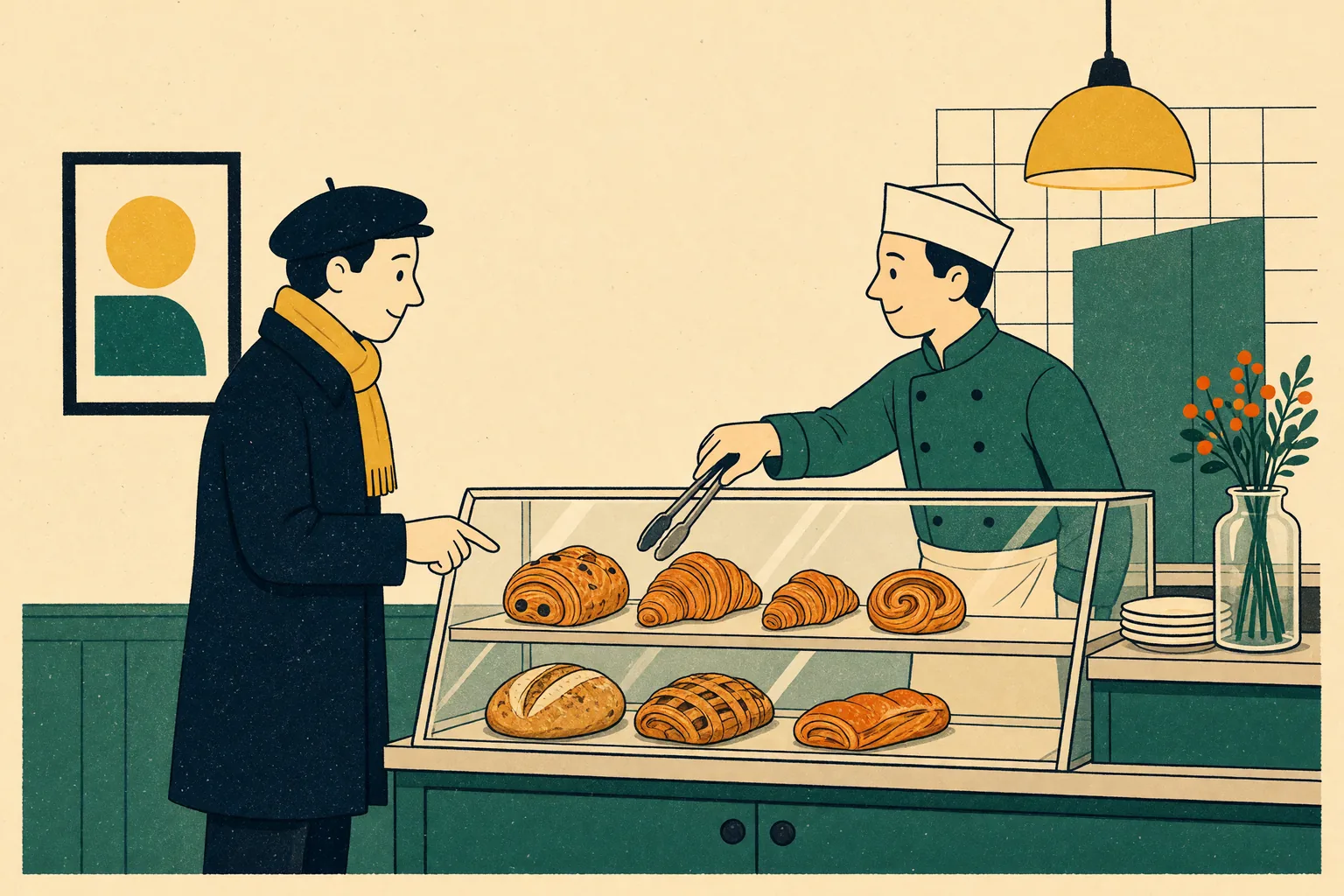
At a bakery: point if you do not know the name
A bakery order can be short:
Bonjour, je vais prendre un croissant, s'il vous plaît.
If you cannot name the pastry, point and say “Celui-là, s'il vous plaît.” Use celui-là for a masculine noun such as un croissant or un gâteau. For a feminine noun such as une tarte, use celle-là. If you have no idea what the item is called, “Ça, s'il vous plaît” (“That, please”) with a clear gesture is a useful alternative.
The person behind the counter may ask “Et avec ceci ?” They are asking whether you want something else. Say “Ce sera tout, merci” (“That will be all, thank you”), or add another item. This follow-up appears in ordinary bakery exchanges, including the recording in this French teacher's bakery lesson.
If the bakery has seating, you may also hear “Sur place ou à emporter ?” Answer sur place for eating there or à emporter for takeaway.
The whole bakery exchange:
A croissant at the bakery
Bonjour !
Hello!
Bonjour, je vais prendre un croissant, s'il vous plaît.
Hello, I'll have a croissant, please.
Et avec ceci ?
Anything else with that?
Celui-là, s'il vous plaît.
That one, please.
Sur place ou à emporter ?
For here or to take away?
À emporter. Ce sera tout, merci.
To take away. That will be all, thank you.
Deux euros trente, s'il vous plaît.
Two euros thirty, please.
At a bar: name the drink and the amount
The same frame works for a glass of wine, a beer, or a soft drink:
Bonsoir, je vais prendre un verre de vin rouge, s'il vous plaît.
That asks for a glass of red wine. Un verre makes the amount clear. For beer, use the type and size shown on the menu if you have a preference; asking for une bière may lead to a question about either.
Listen for a choice rather than trying to translate a whole sentence. If the server names two drinks, you can repeat the one you want. If you do not recognize either, ask them to show you on the menu.
How to ask for the bill in French
At a restaurant or a table in a bar, catch the server's attention and say “L'addition, s'il vous plaît.” At a bakery counter, payment usually follows the order directly, so you generally do not need to ask for a separate bill.
To ask about card payment, use “Je peux payer par carte ?” If you need a moment to understand the total, ask for a repeat or look at the amount displayed. Finishing the exchange calmly is part of ordering too.
Practice the next question, not only your first line
Have someone play the bistro server. Order the chicken, answer the drink question, and ask for the bill. On the second run, ask for a recommendation first so the reply changes.
Here is the bistro exchange at natural speed:
Lunch at the bistro
Bonjour. Vous avez choisi ?
Hello. Have you chosen?
Bonjour. Je vais prendre le poulet, s'il vous plaît.
Hello. I'll have the chicken, please.
Très bien. Et comme boisson ?
Very good. And to drink?
Une carafe d'eau, s'il vous plaît.
A jug of tap water, please.
Tout de suite.
Right away.
L'addition, s'il vous plaît.
The bill, please.
Bien sûr, je vous l'apporte.
Of course, I'll bring it to you.
For practice before you have a partner, the AI conversation guide explains how to keep a roleplay short and useful. If you miss the server's line during a Linguino lesson, replay and translation let you check it and continue.
Linguino's AI teacher turns this Paris bistro into a live spoken exchange, with phrase cards for the lines you need and replies that follow your order. It is one of 52 scenes in each of seven language paths, with custom scenes for other situations; afterwards, a quiz, scored speaking cards, coach feedback, and your Phrasebook give you something to review. Your first sessions are free, three minutes each after email sign-in, with no card required.