Dinner at a restaurant in French, from booking to bill
Je voudrais réserver une table pour deux personnes, ce soir à vingt heures.
“I'd like to book a table for two people, tonight at eight.”
When: The opening line of the phone call
The moment
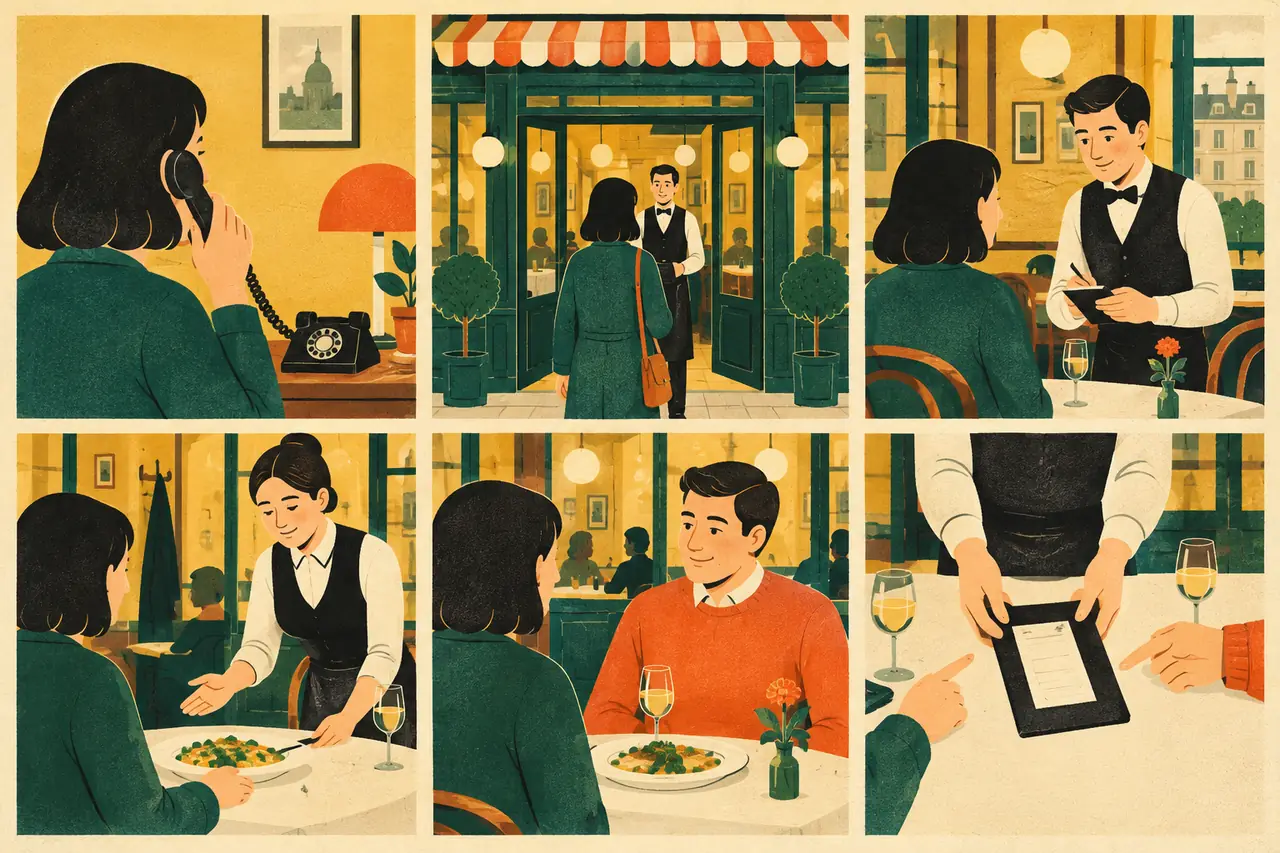
You phone a bistro to book a table for two, arrive and give your name, order for the table, sort out a dish that comes out wrong, then ask to split the bill.
A2 · Unit 1 · Eating out · Checkpoint
This is the unit’s checkpoint: one roleplay that puts the unit’s scenes together.
The lines
The booking line
The whole reservation fits in one sentence: "Je voudrais réserver une table pour deux personnes, ce soir à vingt heures." If they answer on est complet, take their first free time instead of hanging up.
Je voudrais réserver une table pour deux personnes, ce soir à vingt heures.
“I'd like to book a table for two people, tonight at eight.”
When to use it: The opening line of the phone call
What you’ll hear back: C'est à quel nom ? (Under what name?)
The polite send-back
One sentence fixes a wrong plate without friction: "Excusez-moi, je crois qu'il y a une erreur : j'ai commandé le poulet." Name what you did order, then thank them when the right plate arrives.
Excusez-moi, je crois qu'il y a une erreur : j'ai commandé le poulet.
“Excuse me, I think there's a mistake: I ordered the chicken.”
When to use it: When the wrong dish arrives at the table
What you’ll hear back: Je suis désolé, je vous change ça tout de suite. (I'm sorry, I'll swap that right away.)
Words for this scene
| French | Say it | English |
|---|---|---|
| J'ai réservé au nom de Martin | zhay ray-zair-VAY oh NOHN duh mar-TAN | I have a booking under the name Martin |
Bonsoir, j'ai réservé au nom de Martin, pour deux personnes. Good evening, I have a booking under the name Martin, for two. Tip: Say Bonsoir first after 6 pm; skipping it reads as rude. | ||
| Est-ce que vous auriez une table en terrasse ? | ess-kuh voo-zoh-RYAY oon TAH-bluh on teh-RASS | Would you have a table on the terrace? |
On a réservé à l'intérieur, mais est-ce que vous auriez une table en terrasse ? We booked inside, but would you have a table on the terrace? Tip: Terrace tables go first; ask when booking, not on arrival. | ||
| On peut payer séparément ? | on puh pay-YAY say-pah-ray-MON | Can we pay separately? |
L'addition, s'il vous plaît. On peut payer séparément ? The bill, please. Can we pay separately? Tip: Ask as you request the bill; small places may still refuse. | ||
Your objective
Book a table for two, order for both of you, sort out the dish that comes out wrong, and ask to split the bill.
- a table for two
- the wrong dish
- splitting the bill
Lines that get it done
- Je voudrais réserver une table pour deux personnes, ce soir à vingt heures.
- Excusez-moi, je crois qu'il y a une erreur : j'ai commandé le poulet.
- On peut payer séparément ? · Can we pay separately?
In the live scene the objective stays on screen, and the Replay afterwards says whether you got it done.
Check yourself
1. You ask for 8 pm and the host replies "On est complet jusqu'à vingt et une heures." What's the best reply?
- D'accord, alors une table à vingt et une heures, s'il vous plaît.
- D'accord, alors une table à vingt heures, s'il vous plaît.
- D'accord, alors une table à dix-neuf heures trente, s'il vous plaît.
- D'accord, alors une table à vingt heures trente, s'il vous plaît.
Show the answer
D'accord, alors une table à vingt et une heures, s'il vous plaît.
Jusqu'à vingt et une heures means nothing is free before 9 pm, so 9 pm is the earliest you can take.
2. Your friend's dish arrives lukewarm. What do you say to the waiter?
- C'est un peu froid, vous pourriez le réchauffer ?
- C'est un peu froid, vous voulez le réchauffer ?
- C'est un peu froid, il faut le réchauffer.
- C'est un peu froid, on va le réchauffer.
Show the answer
C'est un peu froid, vous pourriez le réchauffer ?
Vous pourriez asks a favour; vous voulez asks what the waiter feels like and il faut tells him what to do.
3. The bill arrives and you each want to pay with your own card. What do you ask?
- On peut payer séparément ?
- On peut payer plus tard ?
- On peut partager le plat ?
- On peut payer en terrasse ?
Show the answer
On peut payer séparément ?
Séparément asks for two payments; partager le plat is about sharing food, not the bill.