What to say when you miss a train in Italian
Scusi, sa perché il treno è in ritardo?
“Excuse me, do you know why the train is late?”
When: At the information desk when the board changes
The moment
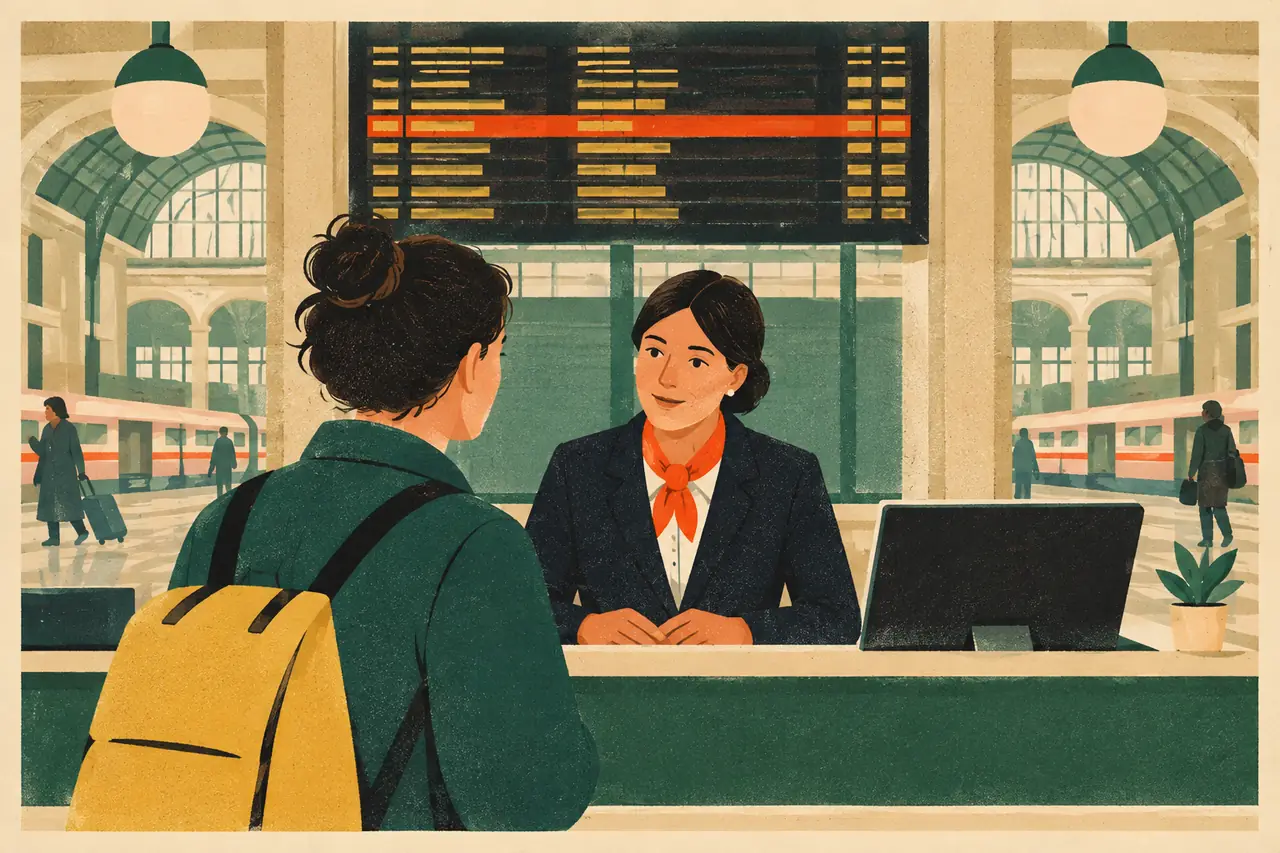
The board at Roma Termini flips your train to ninety minutes late, so your connection in Bologna is gone. You go to the Assistenza Clienti desk to find out what happened, get onto the next train, and ask about your money.
A2 · Unit 2 · Travel days
The lines
Asking why it is late
An Italian train 'è in ritardo', never 'è tardi'. Opening with 'sa perché...?' makes you sound curious instead of angry: 'Scusi, sa perché il treno è in ritardo?'
Scusi, sa perché il treno è in ritardo?
“Excuse me, do you know why the train is late?”
When to use it: At the information desk when the board changes
What you’ll hear back: C'è un guasto sulla linea, ha quaranta minuti di ritardo. (There is a fault on the line, it is forty minutes late.)
Missed it, now fix it
Report today's disaster in the passato prossimo and ask for the fix in the same sentence: 'Ho perso la coincidenza, posso cambiare il biglietto?' The agent then knows both the problem and what you want.
Ho perso la coincidenza, posso cambiare il biglietto?
“I missed my connection, can I change my ticket?”
When to use it: At the Trenitalia customer service desk
What you’ll hear back: Nessun problema, le sposto la prenotazione sul prossimo. (No problem, I will move your booking to the next one.)
Words for this scene
| Italian | Say it | English |
|---|---|---|
| A che ora parte il prossimo? | ah keh OH-rah PAR-teh eel PROS-see-moh | What time does the next one leave? |
Questo treno è già partito, a che ora parte il prossimo? This train has already left, what time does the next one leave? Tip: Say 'il prossimo' on its own; the train or bus is understood. | ||
| Come faccio a chiedere il rimborso? | KOH-meh FAT-choh ah KYEH-deh-reh eel reem-BOR-soh | How do I claim a refund? |
Il treno è arrivato con due ore di ritardo, come faccio a chiedere il rimborso? The train arrived two hours late, how do I claim a refund? Tip: Trenitalia pays out from sixty minutes late, so keep your ticket. | ||
| Da quale binario parte? | dah KWAH-leh bee-NAH-ryoh PAR-teh | Which platform does it leave from? |
Hanno cambiato tutto: da quale binario parte adesso? They have changed everything: which platform does it leave from now? Tip: Platforms change at the last minute in Italy; recheck the board. | ||
Your objective
Explain that you missed your connection, ask why it was late, and get yourself onto the next one.
- the missed connection
- why it was late
- a place on the next one
Lines that get it done
- Ho perso la coincidenza, posso cambiare il biglietto?
- Scusi, sa perché il treno è in ritardo?
- A che ora parte il prossimo? · What time does the next one leave?
In the live scene the objective stays on screen, and the Replay afterwards says whether you got it done.
Check yourself
1. The board shows your train running late. How do you ask why?
- Scusi, sa perché il treno è in ritardo?
- Scusi, sa perché il treno è tardi?
- Scusi, sa perché il treno sta in ritardo?
- Scusi, sa perché il treno fa ritardo?
Show the answer
Scusi, sa perché il treno è in ritardo?
Trains 'sono in ritardo'; 'essere tardi' only talks about the hour of the day.
2. You missed your connection and want the agent to change your ticket. What do you say?
- Ho perso la coincidenza, posso cambiare il biglietto?
- Sono perso la coincidenza, posso cambiare il biglietto?
- Ho perso la coincidenza, posso cambio il biglietto?
- Ho perso la coincidenza, posso di cambiare il biglietto?
Show the answer
Ho perso la coincidenza, posso cambiare il biglietto?
'Perdere' takes 'avere' in the passato prossimo and 'posso' is followed straight by the infinitive.
3. They have moved your train. How do you ask which platform it leaves from?
- Da quale binario parte?
- Da quale banchina parte?
- Da quale binario parta?
- Da quale binario partono?
Show the answer
Da quale binario parte?
Italian trains leave 'da un binario', and the numbered platform is the 'binario', not the 'banchina'.