Renting an apartment in Italian: keys, rules and repairs
Dove ritiro le chiavi?
“Where do I pick up the keys?”
When: Calling or messaging the host before you arrive
The moment
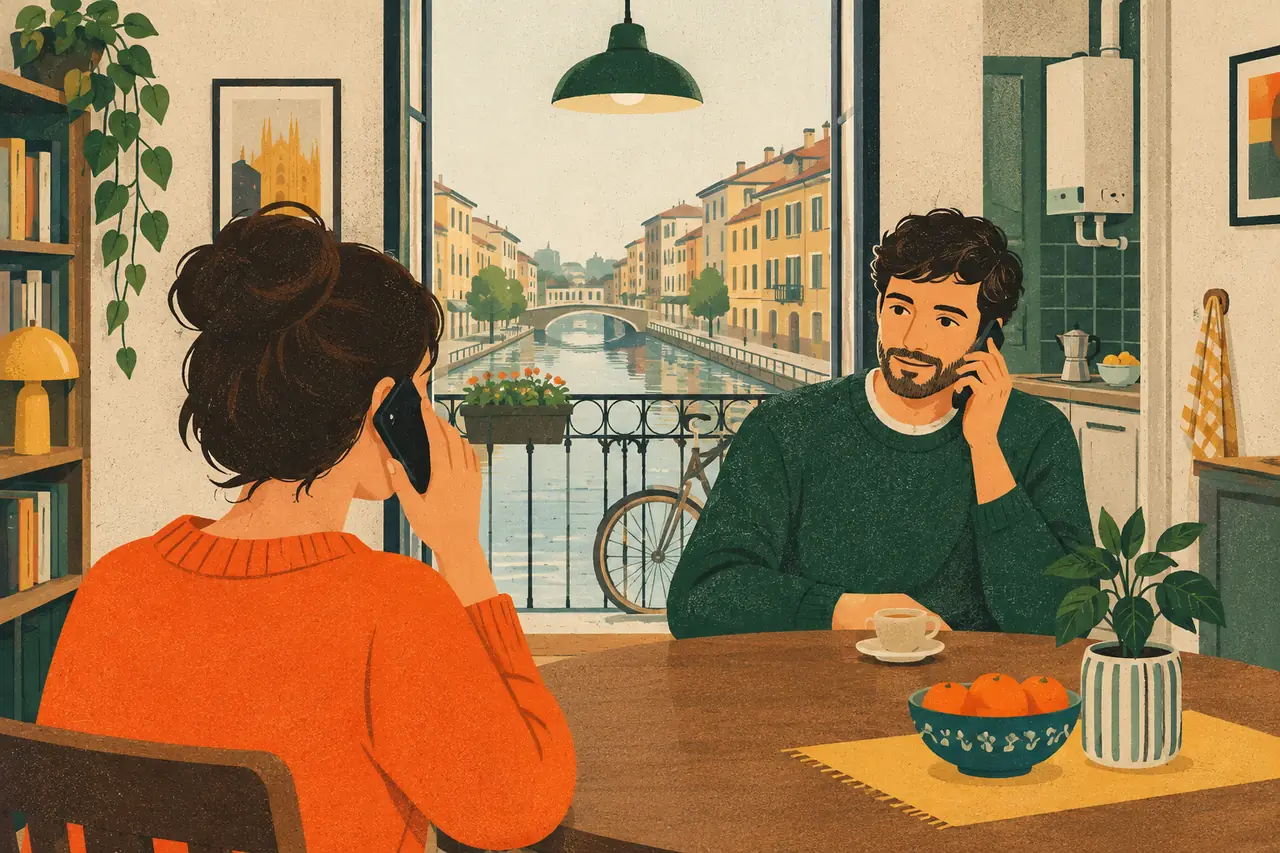
You have rented a flat in the Navigli in Milan for four nights and you are on the phone with Luca, the host. You need the keys, the rules about bills and bins, and the boiler has just died.
A2 · Unit 2 · Travel days
The lines
Getting the keys
Hosts expect one short question: 'Dove ritiro le chiavi?' The plain present tense already covers the near future, so you never need a future form here.
Dove ritiro le chiavi?
“Where do I pick up the keys?”
When to use it: Calling or messaging the host before you arrive
What you’ll hear back: Nella cassetta accanto al portone, ti mando il codice. (In the lockbox next to the main door, I will send you the code.)
Things break by themselves
Italian lets the object break on its own: 'Si è rotta la caldaia e non c'è acqua calda.' It reports the fault without admitting you caused it, and 'rotta' agrees with the feminine 'caldaia'.
Si è rotta la caldaia e non c'è acqua calda.
“The boiler has broken and there's no hot water.”
When to use it: Messaging the host when something in the flat fails
What you’ll hear back: Scusa, chiamo subito il tecnico. (Sorry, I will call the technician right away.)
Words for this scene
| Italian | Say it | English |
|---|---|---|
| Si può usare la lavatrice la sera? | see pwoh oo-ZAH-reh lah lah-vah-TREE-cheh lah SEH-rah | Is it allowed to run the washing machine in the evening? |
Ciao Luca, si può usare la lavatrice la sera o disturbo i vicini? Hi Luca, is it allowed to run the washing machine in the evening or will I bother the neighbours? Tip: Condominio rules often forbid noisy appliances after ten at night. | ||
| Le bollette sono incluse? | leh bol-LET-teh SOH-noh een-KLOO-zeh | Are the utility bills included? |
Prima di confermare: le bollette sono incluse nel prezzo? Before I confirm: are the utility bills included in the price? Tip: 'Le bollette' covers electricity, gas and water in one word. | ||
| Dove si butta la spazzatura? | DOH-veh see BOOT-tah lah spat-tsah-TOO-rah | Where do you put out the rubbish? |
Scusa, dove si butta la spazzatura qui in cortile? Sorry, where do you put out the rubbish here in the courtyard? Tip: Italy sorts strictly; ask which coloured bag goes out which night. | ||
Your objective
Find out how to get in, then report the problem with the water and ask when someone can fix it.
- how to get in
- the water problem
- when it can be fixed
Lines that get it done
- Dove ritiro le chiavi?
- Si è rotta la caldaia e non c'è acqua calda.
In the live scene the objective stays on screen, and the Replay afterwards says whether you got it done.
Check yourself
1. You land tonight. How do you ask the host where you pick up the keys?
- Dove ritiro le chiavi?
- Dove ritiro i chiavi?
- Dove ritiro la chiavi?
- Dove sono ritirare le chiavi?
Show the answer
Dove ritiro le chiavi?
'Chiavi' is feminine plural, and the present tense of 'ritirare' already covers your arrival.
2. The boiler has died and there is no hot water. How do you tell the host?
- Si è rotta la caldaia e non c'è acqua calda.
- Si ha rotta la caldaia e non c'è acqua calda.
- Si è rotto la caldaia e non c'è acqua calda.
- Si è rotta la caldaia e non ci ha acqua calda.
Show the answer
Si è rotta la caldaia e non c'è acqua calda.
'Rompersi' takes 'essere', the participle agrees with the feminine 'caldaia', and existence is 'c'è'.
3. How do you ask whether running the washing machine in the evening is allowed?
- Si può usare la lavatrice la sera?
- Si può uso la lavatrice la sera?
- Si può usando la lavatrice la sera?
- Puoi usare la lavatrice la sera?
Show the answer
Si può usare la lavatrice la sera?
'Si può' plus an infinitive asks about the rule; 'puoi' would ask what the host himself may do.