How to Practice Speaking French Alone: 5 Ways
How to practice speaking French alone: shadow a clip, narrate your day, record one answer, rehearse a scene from both sides, talk to an AI. 12 minutes.
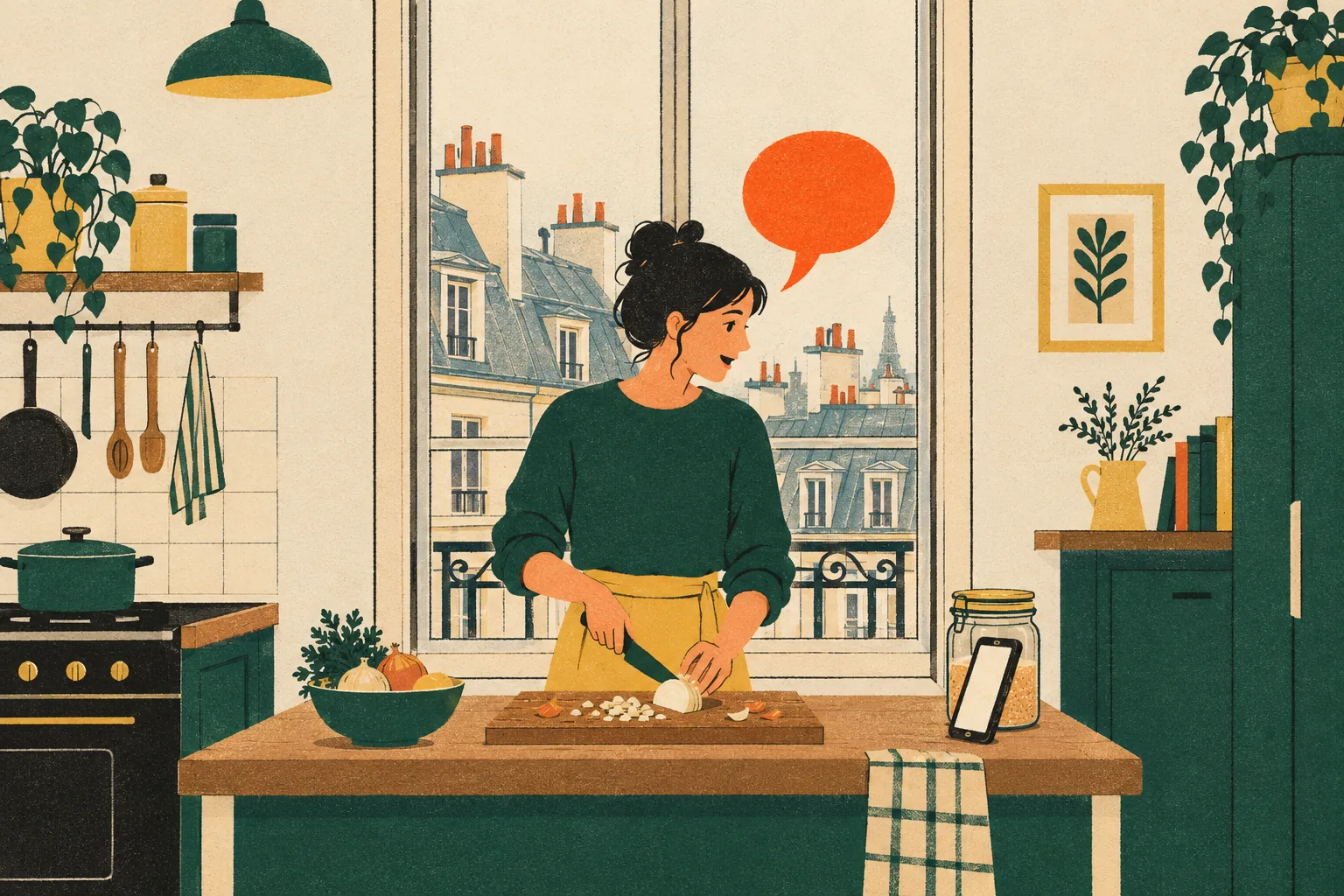
Linguino · Oct 26, 2026 · 10 min read
You can practice speaking French alone, and every method that works does one of three jobs: it puts good French in your mouth (shadowing), it makes you find words with nothing to read (narrating, voice notes), or it makes you answer something you did not choose (a rehearsed scene, a live AI partner). The five ways below cover all three. Each one says what it trains and what it cannot, and the end of the post puts them into a twelve-minute routine.
French has one extra problem to plan for. The distance between the written word and the spoken one is larger than in Spanish or Italian: silent endings, liaison that joins words, je shrinking to j'. A solo routine built on reading will not close that gap. Everything below is done out loud, and most of it is done with your eyes off the page.
What practicing alone can and cannot train
Take a small exchange: a neighbor asks how your day was. In the two seconds you have, you must find a verb in the past, say it with the right sounds, understand her reaction, decide what to ask back, and keep going if a word is missing. That is five skills, and no single solo exercise trains all five.
Shadowing works on the sounds and rhythm, but the recording decides every word. Narrating makes you find words, but nobody answers. A rehearsed scene adds turns, but you wrote both sides. Only a partner who answers back trains the last two, which is why the fifth way is a conversation. Use the first four to prepare for it, not instead of it.
1. Shadow ten seconds of real French
Shadowing means speaking at the same time as a recording, a fraction of a second behind the voice. Pick ten to twenty seconds of clear French with a transcript: one exchange, not a news bulletin. Listen once, read once, then replay it and speak with the voice. Five repetitions of one short piece do more than one pass of a long one.
Listen for the things French does that English does not:
- Where two words join: vous avez said as one word, with a z in the middle.
- Where a letter is written and not said: the t of petit, the s of vous when it stands alone.
- Where the voice rises: a question in French often keeps the word order of a statement and rises at the end.
- Which syllable is held: in French it is nearly always the last one of the group.
Shadowing is the fastest way to stop reading French with English sounds. How to read French out loud explains the accents, the silent letters and liaison if you want the rules behind what you hear, and how to understand spoken French covers the other direction: why real French sounds so fast and what to listen for. Shadowing cannot make you choose a word, so move on after two minutes.
2. Narrate what you are doing
"Talk to yourself in French" is good advice with no instructions. Give it a task and a clock. For sixty seconds, say out loud what you are doing right now, in the present: je coupe les oignons, je cherche mes clés, je sors. Then, in the evening, say what you did, in the past: j'ai travaillé, j'ai mangé, j'ai marché.
When a word is missing, do not stop to look it up. Say the sentence around the hole: "je mets le... le truc pour le café" ("the thing for the coffee"). Keeping a sentence alive without the word is the skill a conversation needs most, and it is the one reading never trains. Look up at most three words at the end of the minute, then say the same minute again with them in it.
This is what Linguino's narrate mode does with a coach in the room: you say what you are doing in French, the coach gives you the word you were missing and shows it on screen, says your sentence back the right way when you slip, and asks a short question about what you are doing. The help article on the daily call and narrate mode explains how to start it. On your own, a kitchen timer and your own voice are enough.
Narrating trains retrieval under a little time pressure. It does not tell you whether anyone could follow you, so the next method adds a listener: you.
3. Record one answer and listen once
Ask yourself one question out loud and answer it for a minute into your phone: Et vous, votre journée ? ("And your day?"). Then listen back once, for one thing only:
- A pause before an ordinary word (that word goes on tomorrow's list).
- A liaison you skipped, or one you added where there is none.
- The French u, in tu and vu, drifting toward the English oo.
- A sentence that grew too long to finish.
Choose one of them, record the answer again, and stop. Two recordings, one change. If you go looking for every mistake, the exercise turns into editing and you will not do it tomorrow. Listening to your own French is uncomfortable for everyone at first. Delete the file after the second take if that helps you press record.
4. Rehearse a scene from both sides
A scene gives self-talk the structure of a conversation. Here is one from Linguino's French path, from the unit about your daily life. It is six in the evening in the kitchen of your Paris co-working space, and a woman you have met before asks how your day went. You say what you did in a few words, react to her news, and keep her talking.
| Say | Sounds like | Means |
|---|---|---|
| J'ai travaillé ce matin. | zhay tra-va-YAY suh ma-TAN | I worked this morning. |
| Et vous, votre journée ? | ay VOO, VOT-ruh zhoor-NAY | And your day? |
| Rien de spécial. | ryan duh spay-SYAL | Nothing special. |
| Ah bon ? | ah BOHN | Oh really? |
| C'était sympa. | say-teh sam-PAH | It was nice. |
| J'ai dîné avec des amis, c'était sympa. | zhay dee-NAY a-vek day za-MEE, say-teh sam-PAH | I had dinner with friends, it was nice. |
Two things in this scene are worth more than the vocabulary. First, j'ai plus the action is all you need to report a whole day: j'ai travaillé, j'ai mangé, j'ai dormi, only the last word changes. Second, the moment you have answered, hand the question back with Et vous, votre journée ? In France, skipping that question makes you sound uninterested. And Ah bon ? only works with the voice rising; said flat, it sounds like doubt.
To rehearse alone, write only her lines on a card and answer each one aloud:
- Alors, votre journée ?
- Ah bon ? Et cet après-midi ?
- Tranquille, merci. J'ai travaillé à la maison.
On the second run, change one thing: you had lunch out instead of working, or her news is that she just got back from Rome, and you have to react. You can also let her speak instead of reading the card: the talk about your day scene page has every line of the lesson with its meaning and audio, and starts the live version in one tap. For other situations, introducing yourself in French and ordering in French give you the lines for a first meeting and for a bakery, a bistro or a bar.
5. Talk to someone who answers back
A rehearsed scene has one limit you cannot fix alone: you wrote both sides, so nothing surprises you. A live AI partner reacts to the words you actually say, waits while you find them, and takes the conversation somewhere you did not plan.
In Linguino the French path is a neighborhood, Le 11e in Paris, with people who come back: Nadia the baker, Gilles at the corner café, Yanis the neighbor who plays bass. Each scene is a spoken conversation with one of them, and the daily call is the simplest way to use it alone: someone from the neighborhood rings you for a three-minute chat in French, you do most of the talking, and the first call each day is free. Le 11e and the daily call are explained in the help centre. If you would rather start with a scene, the French path lists all 52 with their phrases.
Be honest about what an AI partner is. It is patient, available at eleven at night, and never bored by your fourth attempt at the same line. It can also accept a sentence a Parisian would frown at, or correct one that was fine. Use it for turns and repetitions, and check a cultural or grammatical doubt with a teacher or a trusted reference. The point is the two seconds between her question and your answer. Nothing on this list trains those two seconds except a partner who waits for them.
When to find a person
At some stage you want a real voice, with a real accent and a real opinion about your r. A language exchange gives you that. It also costs you half the call in English, and partners differ in reliability and in how well they explain a correction. Agree the split and the topic before you start, and bring a scene instead of "What shall we talk about?": five minutes of ordering lunch, then swap roles.
Until then, the solo routine is not a substitute for conversation. It is how you arrive at the conversation with sentences ready.
A twelve-minute routine for practicing French alone
You do not need a study plan. You need twelve minutes, in this order:
Minutes 0 to 2: shadow. One short exchange, five times, eyes on the transcript the first time only.
Minutes 2 to 4: recall. Hide the transcript. Say the same lines from the English meaning.
Minutes 4 to 7: run a scene. Answer three or four of the other person's lines out loud. Ask for a repeat at least once: Pardon ?
Minutes 7 to 9: change one detail. The same scene with a different answer, a different time, a different piece of news to react to.
Minutes 9 to 11: narrate. One minute on what you did today, out loud, in the past tense.
Minute 12: keep one line. The sentence that blocked you goes on a card. Say it first tomorrow.
On a bad day, do minutes 4 to 7 only. A three-minute scene you actually ran is worth more than a twelve-minute routine you postponed. The Spanish version of this routine works the same way if you are learning both.
How to know it is working
Do not count words learned. Watch what changes when you speak:
- You open a familiar scene without translating the first line in your head.
- Your pauses move from common words to rare ones.
- You can ask for a repeat without leaving French.
- You can change one detail without losing the whole sentence.
- You hear vous avez as one word and answer it as one word.
Run the same scene again after two or three days. Familiarity is not cheating: it frees attention for the sounds and for listening. Then move to a neighboring scene, a bakery after a café, a weekend after a day.
Linguino is built for the part the solo methods cannot supply. Every lesson is a live spoken conversation with an AI teacher who briefs the scene, teaches the lines that matter, then plays the other person, the neighbor, the baker, the colleague, and adapts to what you say; phrase cards appear mid-conversation with the line, its sound and its meaning when you get stuck. Seven languages, 52 scenes each, and in French a neighborhood whose people remember you. Free: 3 sessions a day, 3 minutes each, with just your email.
If you do not know where to start, let a three-minute spoken placement chat choose your level from what you can say, not from what you can recognize on a screen.