Two Weeks Until Your Trip to Brazil: A Speaking Plan
Learn Portuguese for a trip to Brazil in two weeks: one spoken scene a day, from the bakery greeting to the beach kiosk, the metro and the hotel desk.
Linguino · Oct 31, 2026 · 7 min read
You will not learn Portuguese in two weeks. You can prepare the dozen or so conversations your trip is made of, in the order you will meet them, and say each one out loud until the first line comes without thinking. Ten minutes a day is enough, and the plan below fills them.
Two weeks will not let you follow a fast conversation on a Rio bus. It is enough to walk up to a bakery counter, a beach kiosk, a ticket window and a hotel desk and open your mouth. Brazilians are warm with people who try, and a greeting said out loud changes how the whole exchange goes.
Why phrase lists fall short in Brazil
A list of thirty travel phrases helps you read. On the day you need to produce a line in about a second, with someone waiting, and then understand the answer. Brazil also has a habit lists skip: you greet first, and you ask how the other person is, before you order or ask for anything. Walk up to a kiosk and point at the cooler and you come across as cold. That is why the plan starts with the shortest scene of all.
The shape is the same as the Spanish two-week plan: one scene a day, in the order you will meet them, with earlier scenes repeated as you go.
The plan: one scene a day
Every scene below is a live spoken conversation in Linguino, from the Portuguese path. An AI teacher briefs you, teaches two or three lines, then becomes the baker or the ticket seller and answers what you say. The path is Brazilian Portuguese, set in Rio and São Paulo.
| Day | Scene | Where you are |
|---|---|---|
| 1 | Hello and goodbye | A small bakery in Rio in the morning: greet the woman at the counter, answer when she asks how you are, say goodbye |
| 2 | Numbers and prices | A fruit stall in a São Paulo street market: what the mangoes and the strawberries cost |
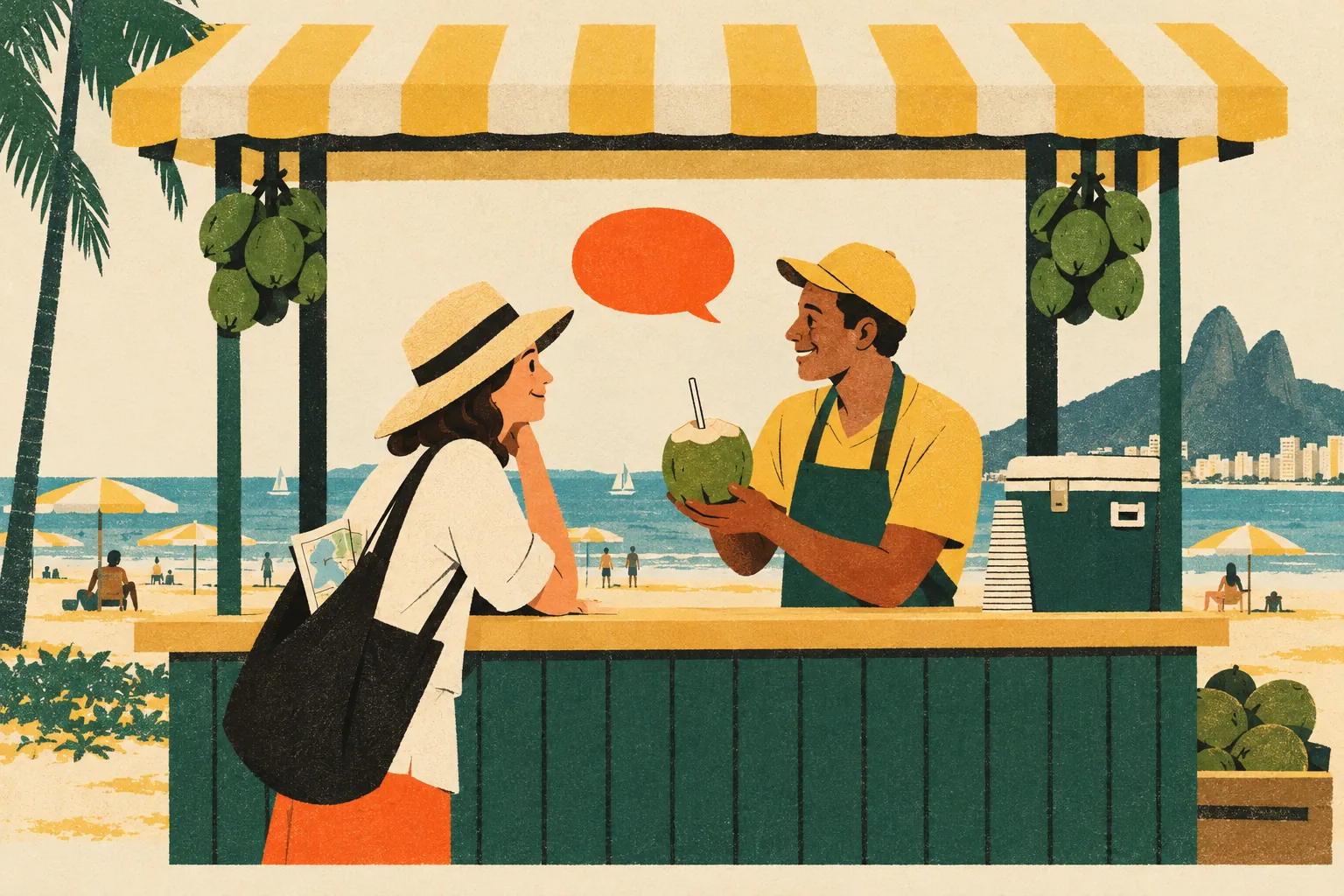
| 3 | At the beach kiosk | A beach kiosk in Rio on a hot afternoon: greet, ask what a coconut water and a pastel cost, buy one |
| 4 | Ordering a meal | A busy lunch place in São Paulo: the menu, a main dish, a drink, a tip on what is good today |
| 5 | Days 1 to 4 again, the two that went worst | |
| 6 | Buying a ticket | The ticket window at Estação da Luz in São Paulo: across town and back tonight, and where it leaves from |
| 7 | Days 3 and 6 again | |
| 8 | Across the city | Leaving a hotel in Copacabana an hour before a match at the Maracanã: which line, the ticket, the platform, a taxi back |
| 9 | Hotel check-in | A hotel in Copacabana after a long day: breakfast time, the wifi password, an air conditioning that works |
| 10 | At the pharmacy | A farmácia on the corner in São Paulo with a pounding head and a stuffy nose |
| 11 | Days 8 to 10 again | |
| 12 | Day 1 and day 8 once more | |
| 13 | The scene that still worries you | |
| 14 | Day 1, then stop |
Days 1 to 4, 6 and 8 are A1 scenes from the first three units of the path, and day 3 and day 8 are the unit checkpoints. Days 9 and 10 are A2 scenes, which are harder; that is the point of doing them after a week of talking. If you want to meet people too, introducing yourself in Portuguese is a good thing to read on a rest day.
The lines that work on every day of the trip
Day one is the shortest scene and the one you will use most. The bakery teaches this:
| Say | Sounds like | Means |
|---|---|---|
| Bom dia! | bohm JEE-ah | Good morning (before midday; after midday it is Boa tarde) |
| Oi, tudo bem? | oy, TOO-doo beng | Hello, how are you? (hello and how are you at once; nobody expects a real report) |
| Tudo ótimo! | TOO-doo OH-chee-moo | Everything's great! |
| Boa noite! | BOH-ah NOY-chee | Good evening, or good night when you leave |
| Tchau, até logo! | chow, ah-TEH LOH-goo | Bye, see you soon! |
Three things to know. The greeting follows the clock, so bom dia before midday and boa tarde after it. The answer is upbeat: the scene notes that a gloomy answer worries a stranger. And never leave in silence; Brazilians sign off out loud, so say tchau, até logo on your way out.
At the beach kiosk on day three the scene stacks two of those greetings, Boa tarde, tudo bem?, so the vendor warms up before you ask for anything. After that, the lines you need are small: Me vê dois, por favor (give me two, please) at the fruit stall, Tá baratinho! (that's nice and cheap!) when the price is good, and Pode repetir? (can you say that again?) when it goes too fast. Say that last one early rather than nodding along.
How to spend the ten minutes
- Minutes 1 to 3: the scene, live. Do the day's conversation once. Say the lines, hear the reply, deal with it. If a word is missing, say what you can and ask again.
- Minutes 4 to 6: the same scene again. The first line should come faster and the reply should need less thinking. If it does not, a third time is better than a new scene.
- Minutes 7 to 10: one old scene. Pick the day that went worst and run it once. By day 14 you will have met the bakery and the kiosk five or six times each, which is how a line stops being a line and becomes something you say.
Count turns, not minutes. A day where you spoke twenty times in Portuguese is a good day, even if half were oi and por favor. The five-minute language habit explains why a short daily session beats a long weekend one.
What to leave out
- Reading. You do not need to read a menu to order well. If you want to know how the spelling maps to the sounds, how to read Portuguese is a calm explanation, but it can wait.
- Grammar tables. You do not need to know why a sentence works. You need to say it.
- Perfect listening. You will not follow a fast conversation. You will catch a price, a platform number and a time, and that is what the scenes practice. Understanding spoken Portuguese is for the longer road.
- Long sessions. Ten minutes a day for fourteen days beats two hours on the Sunday before you fly.
If your trip is on the calendar
Free: 3 sessions a day, 3 minutes each. That covers a scene a day at a short length. If you want longer sessions, or scenes for your exact trip (a family dinner in Salvador, a week of work in São Paulo), a mission plans the scenes backwards from your travel date: path scenes like the ones above, two or three custom ones, a dress rehearsal near the end, and a short list of key phrases for the day itself. Missions come with Starter, Fluent or the mission pack.
Linguino is built for this: every lesson is a live spoken conversation with an AI teacher who plays the other person and reacts to what you say. When you get stuck, a Help button gives you a way in, and what you practice goes into your phrasebook for the plane. You start with just your email.
Day one is the bakery. It takes three minutes, and you will use its first word every day you are in Brazil.