Two Weeks Until Your Trip to Mexico: A Speaking Plan
Spanish for a trip to Mexico in two weeks: one spoken scene a day in trip order, the market, taxi and hotel lines, and the words that change in Mexico.
Linguino · Oct 26, 2026 · 8 min read
Spanish for a trip to Mexico in two weeks is not a vocabulary list. It is about ten conversations: a taxi from the airport, a hotel desk, a market stall with no price tags, a menu you cannot fully read, a pharmacy, a question about the way to the metro. Prepare those ten, out loud, in the order you will meet them, and practice each one until the first line comes without thinking. That takes about ten minutes a day, and fourteen days is enough for it.
One thing makes this plan different from a Spain plan: Mexico speaks its own Spanish. The grammar you learned still works, but the words for a car, a bus, a phone and a juice are different, nobody says vosotros, and "sorry, what?" is ¿mande?. Below is the plan, the first scene's real lines, the words that change, and how to make your teacher speak like Mexico City from the first session.
Set your teacher to Mexico before day one
Linguino's Spanish path is written in Spain, so the scenes are set in Madrid and the written notes count in euros. You can change where your teacher comes from. After you sign in, open your notebook (Notebook in your account menu, top right) and find "Your teacher". For Spanish, choose Mexico (Mexico City). The setting saves right away and your next lesson uses it. Choose where your teacher's language comes from explains the choices.
From then on the teacher speaks the way people do in Mexico City: ustedes for "you all", never vosotros; the Mexican words, carro, celular, jugo, camión, ¿mande?; and the accent, where z and c before e or i sound like s. A scene set in Madrid moves to a similar place in Mexico City. When a phrase from the lesson is said differently there, the teacher shows you the local way once and tells you what is different. Either way is fine when you answer; it is the same Spanish.
There is no link that sets this for you yet, so do it by hand before day one. It takes a minute. For the full list of what changes between Madrid, Mexico City and Buenos Aires, see Spanish in Madrid, Mexico City or Buenos Aires.
The plan: one scene a day
Each day is one situation, practiced as a spoken scene with your teacher playing the other person. The order follows your trip: by the time you arrive you have already said the address to a driver, and by the first evening you have already ordered dinner.
| Day | Scene | What you have to be able to say |
|---|---|---|
| 1 | Numbers and prices | ¿Cuánto cuesta?, catching the number in the answer, and checking it back |
| 2 | A taxi | Say where you are going, ask roughly what it costs, pay |
| 3 | Hotel check-in | Your booking, breakfast and the wifi, a room that needs fixing |
| 4 | Ordering a meal | Ask for the menu, order a main dish and a drink, ask what they recommend |
| 5 | What is in a dish | Ask what a dish has in it, say what you cannot eat, ask for it without something |
| 6 | Paying and the receipt | Card or cash, the total, a receipt |
| 7 | Review day | Days 1 to 6 again, without reading the lines first |
| 8 | Directions | Ask where the metro is and follow the answer |
| 9 | Tickets | A ticket to somewhere, a return, which platform |
| 10 | The pharmacy | Say what hurts and ask for something for it |
| 11 | Review day | Days 8 to 10 again, without the lines |
| 12 | Numbers and prices, again | Day 1 at normal speed, no pauses |
| 13 | Your three hardest scenes | The three you are least sure of, in a row |
| 14 | Mixed day | Three scenes from the list, in random order, at normal speed |
Two honest notes on the scenes. The ticket scene on day 9 is a train ticket at a station; in Mexico City you will more often buy a Metro card or a bus ticket, and the lines carry over, but the place does not. And the paying scene teaches a receipt in a shop; in a market you pay the stallholder and that is the whole exchange.
Days 7, 11 and 14 are the ones people skip, and they are the ones that build recall. Repeating a scene without the written lines is where a line becomes yours. If you already did the Spain version of this plan, the shape is the same; the scenes, the order and the words are not.
Day one: a market stall with no price tags
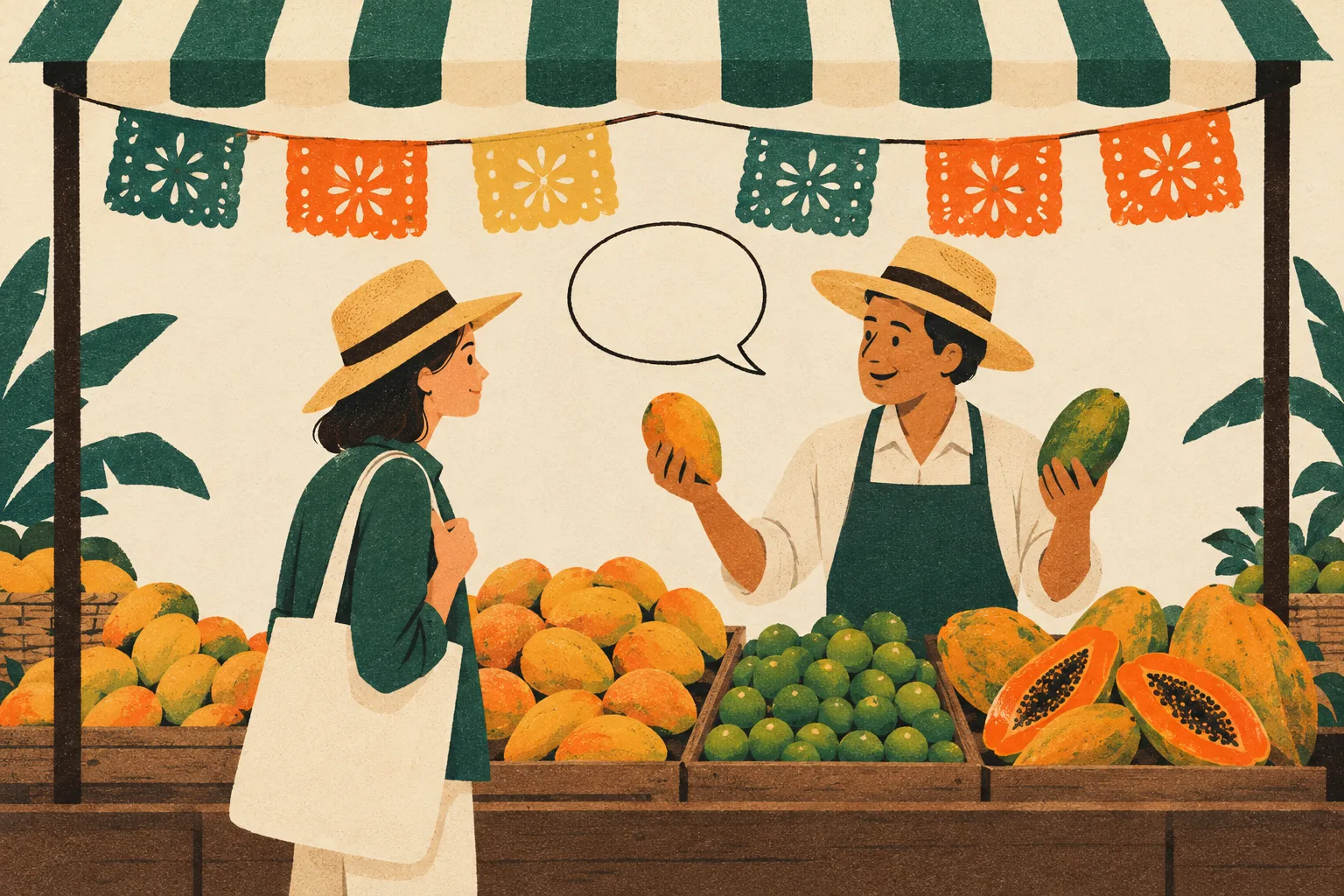
Here is the first scene, from the Spanish path's first unit. You are at a busy market, fruit and snacks piled high and no price on anything. You want to know what two of them cost before you hand over any money.
| Say | Sounds like | Means |
|---|---|---|
| ¿Cuánto cuesta? | KWAN-toh KWES-tah | How much is it? |
| Son dos euros cincuenta. | son dos EH-oo-ros theen-KWEN-tah | It's two euros fifty. |
| Sí, eso es. | see, EH-soh ess | Yes, that's right. |
| ¿Cuánto es todo? | KWAN-toh ess TOH-doh | How much is it all? |
| Es muy caro. | ess mwee KAH-roh | It's very expensive. |
| ¡Qué barato! | keh bah-RAH-toh | That's cheap! |
The second line is how the lesson teaches you to check a price: repeat the number you heard back as a question, and the seller confirms it with sí, eso es. In Mexico the word after the number is pesos, not euros, and with your teacher set to Mexico City the stall moves there, so expect pesos. The number is the part to practice. Prices in Mexico run into the hundreds far more often than in Spain, so the day-one goal is to catch ciento veinte or doscientos cincuenta at speed, not dos con cincuenta.
The pronunciation in the table is Spain's: cincuenta with a th. Your Mexican teacher says it with an s, seen-KWEN-tah, and that is the one to copy for this trip. Es muy caro is fine at a market stall, where a little bargaining is normal; in a shop with marked prices, leave it out. Practice the market scene with a stallholder who answers back.
The words that change in Mexico
These are the ones your teacher will use once you choose Mexico City. None of them will stop a Spaniard understanding you, and none of the Spain words will stop a Mexican, but hearing the local word first saves a second of confusion in every conversation.
- ustedes for "you all". Vosotros is not used in Mexico at all, so you can skip that whole set of verb endings for this trip.
- carro for a car (Spain: coche). Useful on day 2.
- camión for a city bus (Spain: autobús). In Spain a camión is a lorry, so this one surprises people.
- celular for a mobile phone (Spain: móvil).
- jugo for juice (Spain: zumo). Breakfast on day 3.
- ¿mande? for "sorry, what did you say?". You will hear it when you speak too fast or too quietly. Say it yourself when you did not catch a price.
If listening is the part that worries you, the listening guide to understanding spoken Spanish covers the speed and the sounds, and the same approach works for the Mexican accent.
How to spend the ten minutes
Three minutes is one spoken scene. Do the day's scene once, read the phrase cards the teacher shows when you get stuck, then do it a second time without looking at them. On a review day, do the scenes from memory and let the teacher correct you; a wrong word kept the conversation going, and that is the skill you are training. Keep your notes short: the phrasebook fills itself with what you practiced.
Do not add a grammar book, a word list or a podcast in these two weeks. Everything you need to say on the trip is in the fourteen scenes, and every extra minute of study that is not spoken is a minute you will not get back.
Make the trip a mission
If your dates are set, tell your teacher. Open Missions in your account menu, say "a trip to Mexico City" and the date, and in about fifteen seconds you get a plan that counts down to the day: scenes from the path picked for what the trip will need, two or three scenes written for your trip, a dress rehearsal close to the day that runs through the whole thing from start to finish, and five to eight key phrases to glance at before you walk out of the airport. Each step has a due date between today and the day. If the trip is a week away or less, the plan has up to four steps instead of up to ten, which is the honest version of a one-week plan. Missions: get ready for a real day explains how it works and what it comes with.
Linguino is built for exactly this kind of deadline. Every lesson is a live spoken conversation with an AI teacher who plays the other person in the scene, the stallholder, the driver, the hotel receptionist, and adapts to what you say; when you get stuck, a phrase card appears mid-conversation with the line, its pronunciation and its meaning. Choose Mexico City once and every scene, every word and the accent follow. Free: 3 sessions a day, 3 minutes each, with just your email.
Start with day one. A market stall, no price tags, and the number you have to catch.