Two Weeks Until Your Trip to Italy: A Speaking Plan
Learn Italian for a trip in two weeks: one spoken scene a day, in the order Italy meets you, from the morning bar to the pharmacy counter.
Linguino · Oct 30, 2026 · 7 min read
You will not learn Italian in two weeks. You can do something more useful: prepare the dozen or so conversations your trip is actually made of, in the order you will meet them, and say each one out loud until the first line comes without thinking. Ten minutes a day is enough, and the plan below fills them.
Two weeks is not enough time to follow a fast argument at the next table. It is enough to walk into a bar, a ticket office, a hotel lobby and a pharmacy and open your mouth, which is what many visitors never do. Italians are generous with people who try. The person behind the counter will slow down and meet you halfway, but only after you have said the first line.
Why two weeks of phrase lists do not work in Italy
Most "Italian for your trip" pages are a list of thirty phrases. Lists are good for reading and bad for speaking. On the day, you do not need to recognize "a ticket to Florence"; you need to produce it in about a second, with a queue behind you, and then understand the reply that comes back: Per dove, scusi?
Italy also has a habit the lists skip. You greet first. Before you ask for anything, in a bar, a shop or an office, you say Buongiorno to the person behind the counter. Skip it and the rest of your Italian lands cold. That is why the plan starts there, with the shortest scene of all.
If you have done this plan for another country, the shape is the same as the Spanish two-week plan: one scene a day, in the order you will meet them, the earlier scenes repeated as you go.
The plan: one scene a day
Every scene below is a live spoken conversation in Linguino, from the Italian path: an AI teacher briefs you, teaches two or three lines, then becomes the barista or the pharmacist and answers what you say. The scenes are listed in the order a visitor to Rome meets them.
| Day | Scene | Where you are |
|---|---|---|
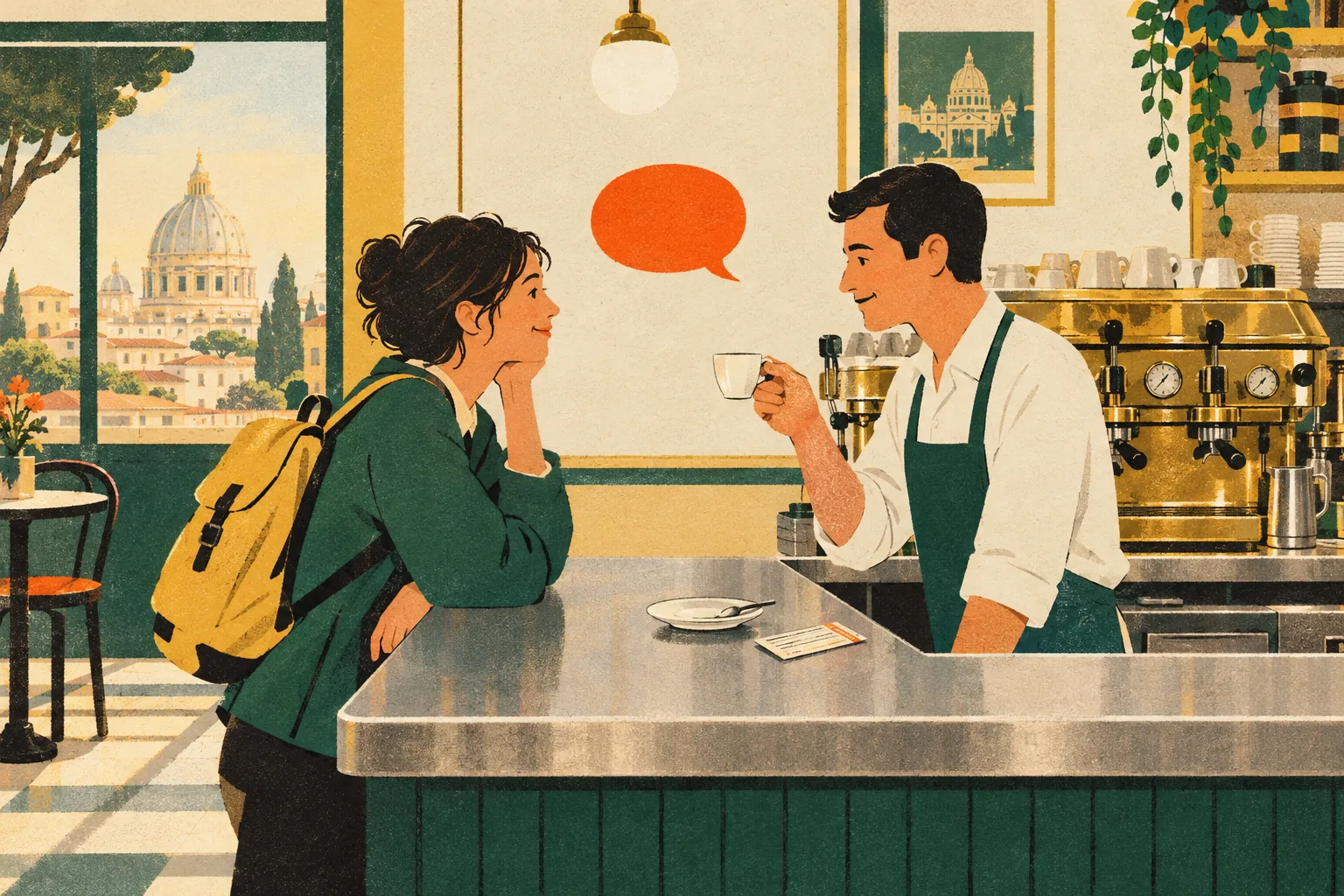
| 1 | Hello and goodbye | A neighbourhood bar in Rome, a morning coffee: greet the barista, answer if he asks how you are, say goodbye |
| 2 | Buying a ticket | The ticket window at Roma Termini: Florence and back the same day, a queue behind you |
| 3 | Taking a taxi | A taxi outside your hotel in Rome: a rough price, the right corner, paying |
| 4 | What's in it? | A lunch spot in Milan: a dish you do not recognise, one thing you cannot eat |
| 5 | Days 1 to 4 again, the two that went worst | |
| 6 | Hotel check-in | A small hotel near Piazza Navona at nine in the evening: your booking, breakfast, wifi, and the air conditioning is dead |
| 7 | Days 2 and 6 again | |
| 8 | At the pharmacy | A farmacia near Piazza Navona: a headache for two days, streaming eyes, something mild and how to take it |
| 9 | Booking a table | A call to a busy trattoria in Trastevere: a table for two tonight, outside if possible, and eight o'clock may be gone |
| 10 | Across the city | One hour before the last entry at the Colosseum: ask which line, buy the ticket, check the platform |
| 11 | Days 8 to 10 again | |
| 12 | Day 1 and day 10 once more | |
| 13 | The scene that still worries you | |
| 14 | Day 1, then stop |
Days 1 to 4 and day 10 are A1 scenes from the first three units of the path. Days 6, 8 and 9 are A2 scenes, and they are harder; that is the point of doing them after a week of talking. Day 10 is the transport unit's checkpoint, and it is the closest thing to a real afternoon in Rome you can have before you go. If you want to prepare for meeting people too, introducing yourself in Italian is a good thing to read on any rest day.
The two lines that work on every day of the trip
Day one is the shortest scene and the one you will use most. Its lines, from the bar:
| Say | Sounds like | Means |
|---|---|---|
| Buongiorno | bwohn-JOR-noh | Good morning (the greeting for strangers, until mid-afternoon) |
| Buongiorno! Mi dica. | bwohn-JOR-noh! mee DEE-kah | Good morning! Go ahead. (what the barista says back) |
| Ciao, come va? | chow, koh-meh VAH | Hi, how are you? (friends and people your own age) |
| Tutto bene, e tu? | TOOT-toh BEH-neh, eh too | All good, and you? (the answer you get back) |
| Salve | SAHL-veh | Hi there (when ciao is too familiar and buongiorno too stiff) |
| Buonasera | bwoh-nah-SEH-rah | Good evening (from about five in the afternoon) |
| Arrivederci | ar-ree-veh-DEHR-chee | Goodbye (to staff and strangers; keep ciao for friends) |
Three things to know, and the scene teaches all of them. Buongiorno comes first, before the order, the question or the ticket. Mi dica is the invitation to speak, so when you hear it, start. And arrivederci is for strangers; ciao is for people you know.
How to spend the ten minutes
- Minutes 1 to 3: the scene, live. Do the day's conversation once. Say the lines, hear the reply, deal with it. Do not stop to look anything up; if a word is missing, say what you can and ask again.
- Minutes 4 to 6: the same scene again. The second time, the first line should come faster and the reply should need less thinking. If it does not, a third time is better than a new scene.
- Minutes 7 to 10: one old scene. Pick the day that went worst so far and run it once. By day 14 you will have met the bar and the ticket window five or six times each, which is how a line stops being a line and becomes something you say.
Count turns, not minutes. A day where you spoke twenty times in Italian is a good day, even if half of them were buongiorno and per favore. The five-minute language habit explains why a short daily session beats a long weekend one, and the same rule holds here.
What to leave out
- Reading. You will not need to read a menu to order well, and the scene on day four teaches you to ask what is in a dish. If you want to know how the spelling maps to the sounds, how to read Italian is a calm explanation, but it can wait.
- Grammar tables. You do not need to know why vorrei prenotare works. You need to say it.
- Perfect listening. You will not follow a fast conversation. You will catch Per dove?, a platform number and a time, and that is what the scenes practice. Understanding spoken Italian is for the longer road.
- Long sessions. Ten minutes a day for fourteen days beats two hours on the Sunday before you fly.
If your trip is on the calendar
Free: 3 sessions a day, 3 minutes each. That covers a scene a day at a short length. If you want longer sessions, or scenes for a trip that is not Rome (a family dinner in Naples, a week of work in Milan), a mission plans the scenes backwards from your travel date: the path scenes above, two or three custom ones for your exact trip, a dress rehearsal near the end, and a short list of key phrases for the day itself. Missions come with Starter, Fluent or the mission pack.
Linguino is built for this: every lesson is a live spoken conversation with an AI teacher who plays the other person, the barista, the pharmacist or the ticket seller, and reacts to what you say. When you get stuck, a Help button gives you a way in, and everything you practice goes into your phrasebook for the plane. You start with just your email.
Day one is the bar. It takes three minutes, and you will use its first word every day you are in Italy.