Two Weeks Until Your Trip to Japan: A Speaking Plan
Learn Japanese for a trip in two weeks: one spoken scene a day, in the order Japan meets you, from the convenience store to the hotel desk.
Linguino · Oct 26, 2026 · 7 min read
You will not learn Japanese in two weeks. You can do something more useful: prepare the ten or so conversations your trip is actually made of, in the order you will meet them, and say each one out loud until the first line comes without thinking. Ten minutes a day is enough, and the plan below fills them.
Two weeks is not enough time to read menus or follow a train announcement. It is enough to walk into a convenience store, a ticket office, a ramen shop and a hotel lobby and open your mouth, which is what most visitors never do. Japan is kind to people who try. The person behind the counter will slow down, point, and meet you halfway, but only after you have said the first line.
Why two weeks of phrase lists do not work in Japan
Most "Japanese for your trip" pages are a list of thirty phrases. Lists are good for reading and bad for speaking. On the day, you do not need to recognize "where is the station"; you need to produce it in about a second, with a queue behind you, and then understand the one-word answer and the pointing that come back.
Japan also has a trap that Spain or Mexico do not: it looks like you can get by without speaking. Big stations and department stores have English signs, and a ticket machine has an English button. Then you step into a drugstore with a headache, a set-meal shop at noon, or a taxi outside your hotel, and there is no button. Those are the moments the plan prepares, and they are the ones you remember.
If you have done this plan for Spain, the shape is the same as the Spanish two-week plan: one scene a day, in the order you will meet them, the earlier scenes repeated as you go.
The plan: one scene a day
Every scene below is a live spoken conversation in Linguino, all but day 11 from the Japanese path: an AI teacher briefs you, teaches two or three lines, then becomes the clerk or the pharmacist and answers what you say. The scenes are listed in the order a visitor to Tokyo meets them.
| Day | Scene | Where you are |
|---|---|---|
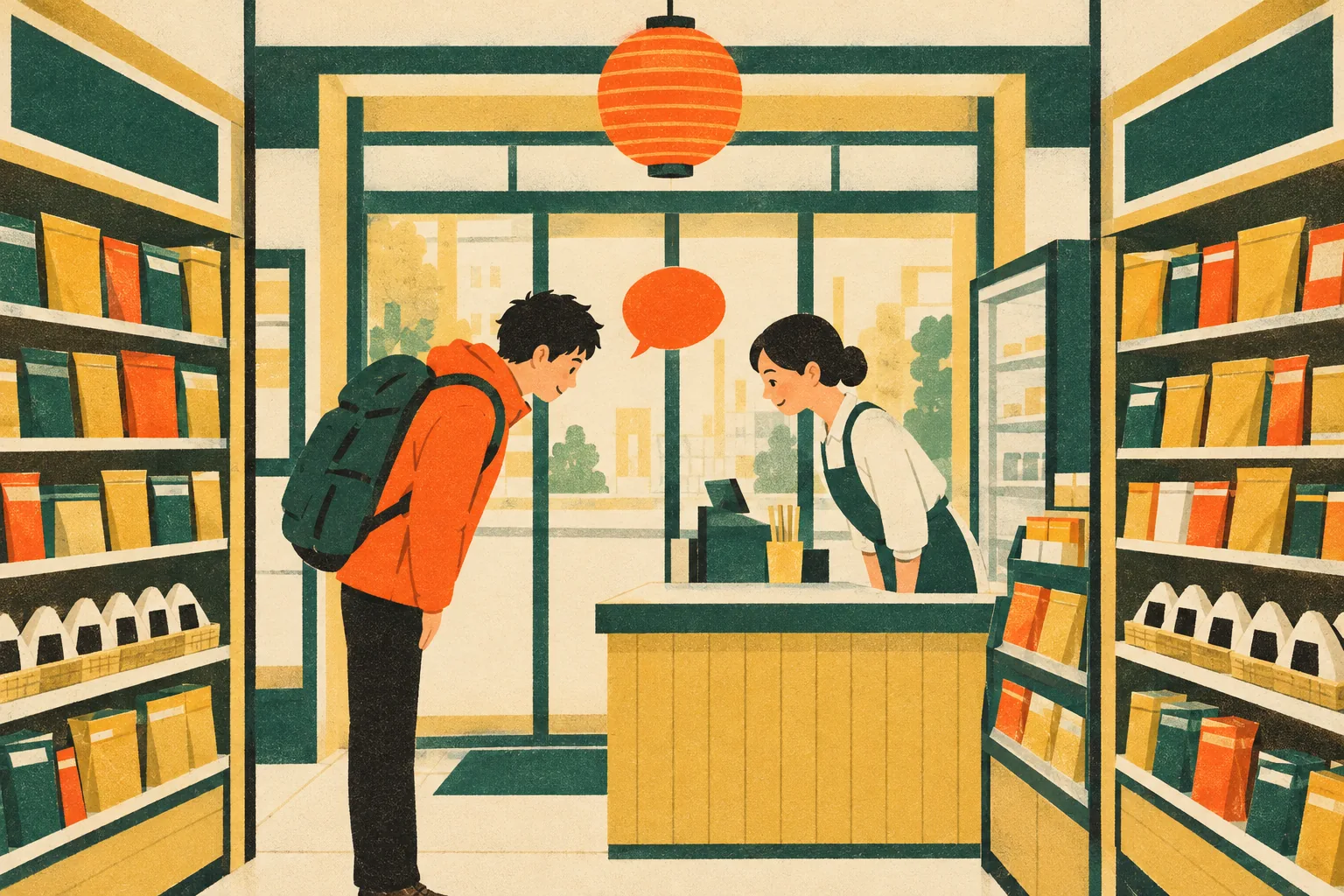
| 1 | Please, thanks, sorry | A busy Tokyo convenience store: squeeze past someone, get a clerk's attention, thank them |
| 2 | Numbers and prices | A souvenir stall in Asakusa: what two things cost, and reacting to the prices |
| 3 | Ordering a meal | A set-meal shop at noon: the menu, one main dish, a drink |
| 4 | What's in it? | A ramen shop: you cannot eat egg, and you would rather skip the spring onion |
| 5 | Buying a ticket | The window at Shinjuku Station: Kamakura for the day, back tonight, a queue behind you |
| 6 | Taking a taxi | Outside your hotel: a rough fare, the right corner, paying |
| 7 | Days 1 to 6 again, the two that went worst | |
| 8 | Hotel check-in | A business hotel in Shinjuku: your booking, breakfast, wifi, and the air conditioner will not turn on |
| 9 | Delays and missed trains | A shinkansen forty minutes late: what happened, a later departure, your money |
| 10 | At the pharmacy | A drugstore: a headache since this morning, what to take and how |
| 11 | Meet someone new | The first real conversation: who you are, where you are from, what you do |
| 12 | Across the city | One hour before Sensoji closes: ask which train, buy the ticket, check the platform |
| 13 | Days 8 to 12 again | |
| 14 | Day 1 and day 12 once more, then stop |
Days 1 to 6 are A1, from the first three units of the path. Days 8 to 10 are A2 scenes, and they are harder; that is the point of doing them after a week of talking. Day 12 is the checkpoint of the transport unit, three short conversations in a row, and it is the closest thing to a real afternoon in Tokyo you can have before you go. Introducing yourself in Japanese covers day 11 in detail if you want to read it first.
The three words that work on every day of the trip
Day one is the shortest scene and the one you will use most. Here are its lines, from the convenience store.
| Say | Sounds like | Means |
|---|---|---|
| すみません。 | sumimasen | Excuse me, sorry, and "over here", all in one word |
| はい、どうしましたか。 | hai, dō shimashita ka | Yes, what can I do for you? (what the clerk says back) |
| お願いします。 | onegai shimasu | Please (I'd like this) |
| ありがとうございます。 | arigatō gozaimasu | Thank you (the full, polite form) |
| いいえ、とんでもないです。 | iie, tondemonai desu | Oh, not at all (what you hear back) |
| どういたしまして。 | dō itashimashite | You're welcome |
| ごめんなさい。 | gomen nasai | I'm sorry (for personal apologies) |
Three things to know, and the scene teaches all of them. Sumimasen does the work of three English phrases: say it to a stranger or a clerk and they turn to you and wait. Onegai shimasu turns anything you point at into a polite request, with no verb needed. And arigatō gozaimasu is the thank-you for strangers and staff; the short arigatō is for friends, and gomen nasai is for a personal apology, not for a shop, where sumimasen fits better.
How to spend the ten minutes
- Minutes 1 to 3: the scene, live. Do the day's conversation once. Say the lines, hear the reply, deal with it. Do not stop to look anything up; if a word is missing, say sumimasen and point.
- Minutes 4 to 6: the same scene again. The second time, the first line should come faster and the reply should need less thinking. If it does not, a third time is better than a new scene.
- Minutes 7 to 10: one old scene. Pick the day that went worst so far and run it once. By day 14 you will have met the convenience store and the ticket window five or six times each, which is how a line stops being a line and becomes something you say.
Count turns, not minutes. A day where you spoke twenty times in Japanese is a good day, even if half of them were sumimasen. The five-minute language habit explains why a short daily session beats a long weekend one, and the same rule holds here.
What to leave out
- Reading. Two weeks will not get you reading a menu, and you do not need it: the set-meal shop has pictures, and the scene on day three teaches you to ask. If you want to understand what the signs are, how to read Japanese is a calm explanation of the three scripts, but it is for after the trip, not before.
- Grammar. You do not need to know why onegai shimasu works. You need to say it.
- Perfect listening. You will not follow a train announcement. You will understand "hai", a number, and a pointed finger, and that is what the scenes practice. Understanding spoken Japanese is for the longer road.
- Long sessions. Ten minutes a day for fourteen days beats two hours on the Sunday before you fly.
If your trip is on the calendar
The free sessions cover this whole plan: three a day, three minutes each, which is the ten minutes above. If you want longer sessions, or scenes for a trip that is not Tokyo (a ryokan, an onsen town, a friend's family in Osaka), a mission plans the scenes backwards from your travel date: the path scenes above, two or three custom ones for your exact trip, a dress rehearsal near the end, and a short list of key phrases for the day itself. Missions come with Starter, Fluent or the mission pack.
Linguino is built for this: every lesson is a live spoken conversation with an AI teacher who plays the other person, the clerk, the pharmacist or the ticket seller, and adapts to what you say. When you get stuck, a phrase card appears mid-conversation with the line, how it sounds and what it means, and everything you practiced goes into your phrasebook for the plane. Seven languages, 52 scenes each, custom scenes for the rest. Free: 3 sessions a day, 3 minutes each, with just your email.
Day one is the convenience store. It takes three minutes, and you will use its three words every hour you are in Japan.