Two Weeks Until Your Trip to France: A Speaking Plan
Two weeks before France? One spoken scene a day in trip order: bakery, café, metro, taxi, hotel, train, pharmacy. About ten minutes a day.
Linguino · Oct 26, 2026 · 7 min read
Two weeks is not enough time to learn French. It is enough time to prepare the dozen short conversations a trip to France is made of, and to say each one out loud until the first line comes without a pause. Do one scene a day, in the order the trip will put them in front of you, for about ten minutes. That is the whole plan.
A visit to Paris is a chain of small, predictable exchanges: a bakery, a café table, the metro, a taxi, a hotel desk, a train ticket, a pharmacy if the weather turns. Each one runs on a few lines, and each one has a reply you need to catch. If you can open the exchange, understand the answer and confirm it, you can get through the day, and the people you talk to will meet you halfway.
Start every exchange with bonjour
One rule matters more in France than any word list. Every exchange begins with "Bonjour", and in a shop or café it often ends with "Au revoir" or "Bonne journée". Skipping the greeting and going straight to your question is not a small mistake there; it reads as rude, and the conversation starts badly. Add "s'il vous plaît" to anything you ask for and you have the frame that every scene below fits inside.
So the plan starts with the greeting, and every later scene opens with it again.
The plan: one Paris scene a day
The scenes are from Linguino's French path, which is set in Paris. Each day is one situation, practiced as a live spoken scene.
| Day | Scene | What you have to be able to do |
|---|---|---|
| 1 | Hello and goodbye | Greet the owner of a neighborhood bakery, ask how she is, leave politely |
| 2 | Numbers and prices | Ask "C'est combien ?" at a market stall on Rue Mouffetard and understand the answer |
| 3 | Order at a café | Order a coffee on a terrace and ask for the bill |
| 4 | Ordering a meal | Lunch at a busy bistro: the menu, a main dish, a drink, a recommendation |
| 5 | Ask for directions | Find the nearest metro station near the Marais and follow the answer |
| 6 | Taking a taxi | Say where you are going, ask roughly how much, get out where you choose |
| 7 | Review day | Days 1 to 6 again, without reading the lines first |
| 8 | Hotel check-in | Give the name on your booking, ask about breakfast and wifi, report a problem with the room |
| 9 | Buying a ticket | A ticket to Lyon at a Paris station: the right kind, the departure time, the platform |
| 10 | Across the city | Hotel to Versailles: ask which line, buy the ticket, check you are going the right way |
| 11 | Booking a table | Phone a bistro in the Marais for a table for two tonight, on the terrace if they have one |
| 12 | At the pharmacy | Explain a sore throat and a cough, and let the pharmacist choose something |
| 13 | Review day | Days 8 to 12 again, at normal speed |
| 14 | Mixed day | Three scenes from the list in random order, with no preparation |
Do not skip the review days. The second time through a scene, your attention is free to listen to the reply.
If restaurants are the part you worry about most, Ordering in French covers the bakery, the bistro and the bar in more depth. If people at your hotel or a dinner will ask about you, How to introduce yourself in French adds names, tu and vous, and la bise.
Day five, line by line: asking for directions
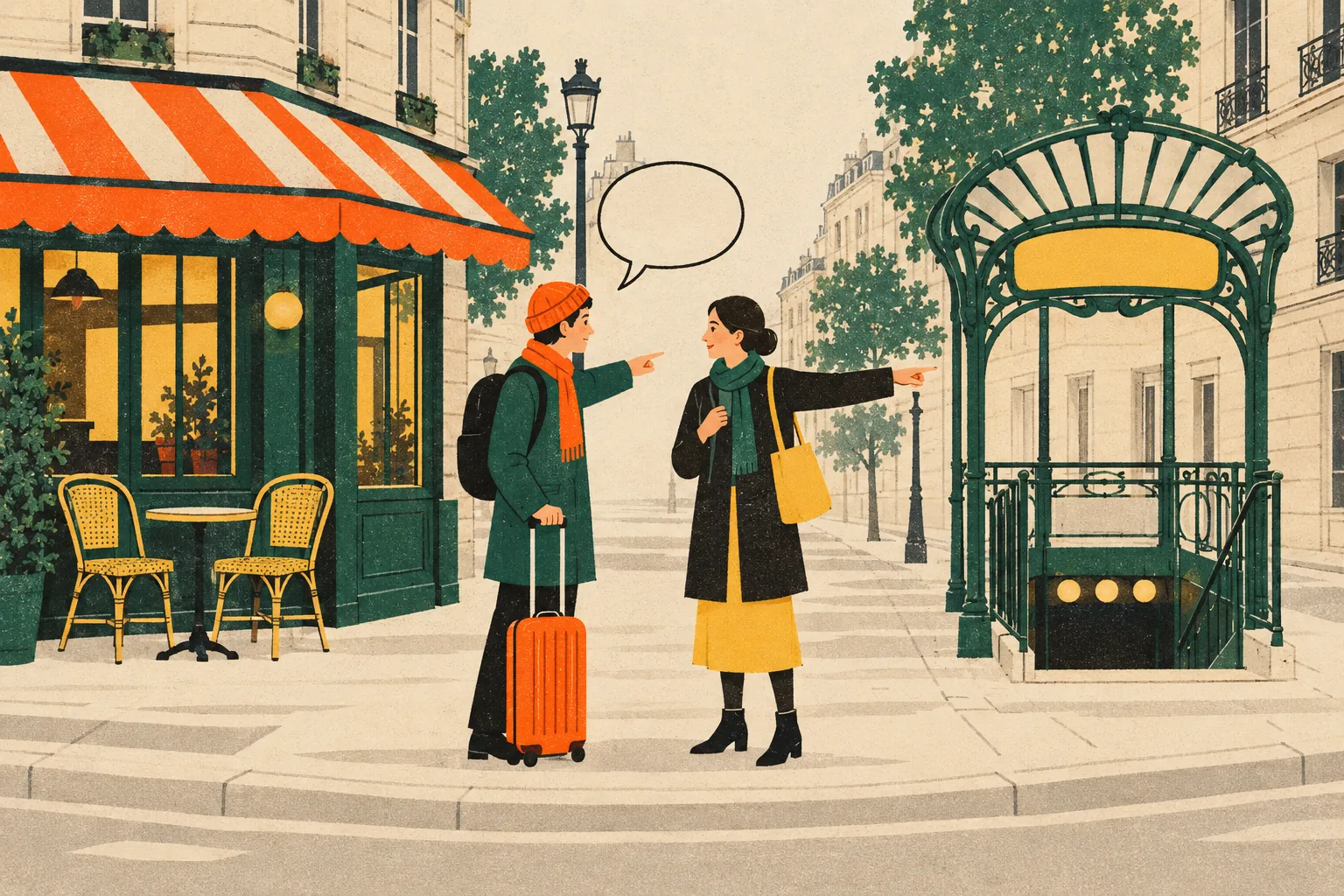
Day five is the first scene where saying your line is the easy part. You ask a stranger for the metro, and the answer comes back fast, with no menu to point at. This scene teaches you to catch a reply and check it.
| Say | Sounds like | Means |
|---|---|---|
| Excusez-moi, je cherche la station de métro | ex-kew-ZAY MWAH, zhuh SHERSH lah stah-SYOHN duh may-TROH | Excuse me, I'm looking for the metro station |
| C'est tout droit, puis à gauche. | say too DRWAH, pwee ah GOHSH | It's straight ahead, then left. |
| Tout droit et ensuite à gauche ? | too DRWAH ay ahn-SWEET ah GOHSH | Straight ahead and then left? |
| Continuez tout droit. | kohn-tee-NWAY too DRWAH | Keep going straight. |
| La station est à droite. | lah stah-SYOHN ay tah DRWAT | The station is on the right. |
Three things in that table are worth more than a long word list.
- "Je cherche…" works for anything. "I am looking for" plus a place is simpler than building a "where is" question, and it works for the metro, the hotel, a pharmacy or a museum.
- Tout droit is not à droite. "Tout droit" (too DRWAH) means straight ahead. "À droite" (ah DRWAT) means to the right. They sound close, and mixing them up sends you the wrong way. Listen for the "tout".
- Repeat the answer back. "Tout droit et ensuite à gauche ?" turns a fast reply you half caught into a yes or no question. If you got it right, you hear "C'est ça". If not, they say it again, often more slowly.
You can read and hear every line of the scene on the ask for directions in French page, then practice it live.
Listen for the reply, not just your line
Most trip plans prepare what you will say and forget what you will hear. In France the reply is often short: "Très bien. Autre chose ?" from the waiter (very good, anything else?), "Tout de suite" when you ask for the bill (right away). If spoken French feels too fast to follow, How to understand spoken French explains why and gives a short daily routine for it.
In each scene, practice two things in order: say your line, then answer what comes back. If the reply surprises you, do not stop. "Vous pouvez répéter ?" (can you say that again?) works in every scene on the list.
If you have less than two weeks
Do days 1, 3, 5, 8 and 12, then the mixed day. The greeting, the café, the metro, the hotel and the pharmacy cover most of what a short city trip asks for. If you have more than two weeks, do not add word lists; repeat the mixed day until every first line comes out without a pause. Before you start, a three-minute spoken level test tells you whether to begin on day 1 or move straight to the hotel and train scenes.
Going to Spain as well? The same two-week plan for Spain follows the same shape with Spanish scenes.
If your trip has a date
A mission turns your travel date into a plan. Open Missions in your account menu, say what is happening and when, and in about fifteen seconds you get a countdown: scenes from the French path picked for your trip, two or three scenes written just for it, a dress rehearsal close to the day, and five to eight key phrases for the day itself. A plan has up to ten steps, or four if the trip is a week away or less. Missions come with Starter, Fluent or a mission pack.
Linguino is built for exactly this kind of deadline. Every lesson is a live spoken conversation with an AI teacher who plays the other person, the baker, the hotel receptionist or the stranger you stop for directions, and answers what you actually say. When you get stuck, a phrase card shows the line, how it sounds and what it means. The French path has 52 scenes across A1, A2 and B1, and on the web they happen in Le 11e, a Paris neighborhood with recurring characters. Free: 3 sessions a day, 3 minutes each, with just your email.
Start with bonjour. Then, on day five, find the metro.